Beyond “I’m Doing Well”: Diverse Ways to Express Your Wellbeing
Knowing how to say “I’m doing well” in various ways is crucial for effective and engaging communication. This article explores a multitude of alternatives, enhancing your ability to express your state of wellbeing with nuance and personality.
There are other ways to say im doing well how are you that can make your responses more engaging and varied. Exploring another way to say doing well allows you to adjust tone depending on the context—formal, casual, or playful. You can also express yourself with i am doing well in different ways, for example: “I’m feeling energized,” or “I’m managing things quite well today.”
For those who want to keep conversations lively, using interesting ways to say im well—like “I’m thriving” or “I’m in good spirits”—adds personality and warmth to your responses.
Off to College Deals

Save up to 30% on everything you need for the semester.
Contains affiliate link
Mastering these expressions will not only enrich your vocabulary but also help you connect better with native English speakers, showcasing a more sophisticated understanding of the language. Whether you are a student, a professional, or simply an English enthusiast, this guide provides a comprehensive overview of expressing your wellbeing.
Table of Contents
- Introduction
- Definition: Expressing Wellbeing
- Structural Breakdown
- Types and Categories of Expressions
- Examples
- Usage Rules
- Common Mistakes
- Practice Exercises
- Advanced Topics
- FAQ
- Conclusion
Definition: Expressing Wellbeing
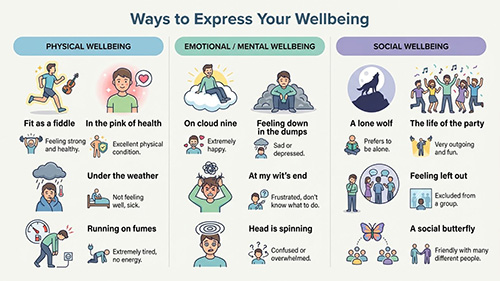
Expressing wellbeing involves communicating your state of health, happiness, and overall condition in a positive or satisfactory manner. It goes beyond simply stating “I’m doing well,” and encompasses a range of phrases and expressions that convey different degrees of positivity, enthusiasm, or neutrality.
The choice of expression often depends on the context, the relationship with the speaker, and the desired level of formality. These expressions serve not only to inform but also to maintain social harmony and build rapport.
The function of expressing wellbeing is multifaceted. It can be a polite response to an inquiry about one’s health (“How are you?”).
Young Adults & Students:
Get 6 Months of Prime for $0

Ages 18-24 unlock exclusive perks including:
Contains affiliate link
It can also be a way to share positive news or feelings with others. Furthermore, the manner in which wellbeing is expressed can reveal aspects of one’s personality, such as optimism, modesty, or even humor.
If you want to emphasize health and overall wellbeing, there are 10 ways to say i am healthy that communicate vitality beyond the standard response. Simple affirmations like i’m doing well thank you or i’m doing well! my business and health are fine show both politeness and completeness.
Other practical phrases include words to say ur doing well, esell, or expressing realistic wellbeing with i’m doing well as to be expected. Using these variations lets you convey your physical, emotional, and professional state clearly while keeping conversations natural and engaging.
Understanding the nuances of these expressions can significantly improve communication skills.
Structural Breakdown
The structure of phrases expressing wellbeing can vary greatly. Some are simple and direct, while others are more complex and figurative.
Generally, these phrases consist of a subject (often “I”), a verb (usually a form of “to be” or “to feel”), and an adjective or adverb that describes the state of wellbeing. However, many idiomatic expressions deviate from this basic structure.
Here’s a breakdown of common structural elements:
- Subject + Verb + Adjective: I am well., I feel good.
- Subject + Verb + Adverb: I am doing well., I am feeling great.
- Idiomatic Expressions: I’m on top of the world., Never better!
Understanding these structural elements allows learners to deconstruct and understand new expressions more easily. It also provides a foundation for creating their own variations, adding personal flair to their communication.
Types and Categories of Expressions
Expressions of wellbeing can be categorized based on the level of positivity and the specific emotions they convey. Here are some common categories:
Positive Affirmations
These expressions directly affirm a state of wellbeing, often emphasizing good health and happiness. They are straightforward and generally suitable for most situations.
Neutral Responses
Neutral responses indicate that one is neither particularly well nor unwell. They are appropriate when one wishes to avoid expressing strong emotions or when one’s state of wellbeing is simply average.
Enthusiastic Expressions
These expressions convey a high degree of happiness and energy. They are best used in informal settings with people one knows well, as they can sometimes be perceived as overly effusive in more formal contexts.
Modest Responses
Modest responses downplay one’s wellbeing, often out of humility or a desire to avoid boasting. They are common in cultures that value understatement.
Figurative Language
Figurative expressions use metaphors and similes to describe one’s state of wellbeing. They add color and personality to communication but should be used with caution, as they may not be understood by everyone, especially non-native speakers.
Examples
The following tables provide extensive examples of different ways to say “I’m doing well,” categorized by the types discussed above. Each table includes a range of options, from simple and direct to more nuanced and expressive.
Positive Affirmations Examples
This table showcases straightforward and positive ways to respond to the question “How are you?” These affirmations clearly state a state of wellbeing.
| Expression | Context |
|---|---|
| I’m well, thank you. | Formal or polite setting |
| I’m good, thanks. | Informal setting |
| I’m doing fine. | General use |
| I’m feeling healthy. | When health is relevant |
| I’m in good spirits. | Expressing a positive mood |
| I’m thriving. | Expressing success and wellbeing |
| I’m doing great. | General use, slightly more enthusiastic |
| Everything is going well. | Broader context |
| I’m in tip-top shape. | Referring to physical health |
| I’m on the mend. | Recovering from something |
| I’m feeling better than ever. | Expressing improved wellbeing |
| I’m as fit as a fiddle. | Idiomatic, emphasizing health |
| Life is good. | Expressing general satisfaction |
| I’m feeling fantastic. | Strong positive affirmation |
| I’m excellent, thank you. | Formal and polite |
| I couldn’t be better. | Strong positive affirmation |
| I’m absolutely fine. | Emphasizing wellbeing |
| I’m doing wonderfully. | Expressing great wellbeing |
| I’m feeling strong. | Referring to physical or mental strength |
| I’m on top of things. | Feeling in control and well |
| I’m in a good place. | Expressing emotional wellbeing |
| I’m feeling amazing. | Expressing a heightened state of wellbeing |
| I’m doing exceptionally well. | Formal and emphatic |
| I’m feeling quite well. | Slightly more formal and polite |
| I’m perfectly fine. | Emphasizing that there are no issues |
| I’m doing alright. | A positive but slightly understated response |
| I’m keeping well. | A more traditional expression, meaning “staying healthy” |
| I’m in the best of health. | A formal way to express excellent health |
Neutral Responses Examples
This table provides examples of neutral responses, suitable when you want to acknowledge the question without conveying strong positive or negative emotions.
| Expression | Context |
|---|---|
| I’m okay. | General use, neither good nor bad |
| I’m alright. | Similar to “okay,” slightly more casual |
| Not bad. | Understated, implying things are acceptable |
| So-so. | Expressing a mediocre state |
| Same as always. | Indicating no change |
| I’m managing. | Implying coping with circumstances |
| I’m hanging in there. | Suggesting perseverance |
| I’m getting by. | Just managing to cope |
| Can’t complain. | Implying things are acceptable, even if not great |
| Nothing to write home about. | Understated, implying nothing special |
| I’m surviving. | Humorous or slightly negative |
| I’m still here. | Humorous, acknowledging existence |
| Just the usual. | Indicating a typical state |
| No better, no worse. | Expressing no change |
| I’m as well as can be expected. | Acknowledging difficult circumstances |
| I’m keeping on. | Similar to “managing” |
| I’m just existing. | Slightly melancholic |
| Another day, another dollar. | Idiomatic, implying routine |
| I’m just plugging along. | Continuing steadily |
| I’m neither here nor there. | Expressing a neutral state |
| I’m so-so, thank you for asking. | Polite and neutral |
| I’m fair to middling. | A slightly old-fashioned expression |
| I’m just getting through the day. | Suggesting a difficult day |
| I’m maintaining. | Similar to “managing” |
| Business as usual. | Implying routine and normalcy |
| I’m average. | Directly stating an average condition |
| I’m not at my best, but I’m okay. | Acknowledging some issues while remaining neutral |
Enthusiastic Expressions Examples
This table provides examples of enthusiastic expressions of wellbeing, suitable for informal contexts and close relationships.
| Expression | Context |
|---|---|
| I’m fantastic! | Expressing great happiness |
| I’m amazing! | Similar to “fantastic,” more emphatic |
| I’m wonderful! | Expressing joy and contentment |
| I’m on top of the world! | Idiomatic, expressing extreme happiness |
| Never better! | Expressing the best possible state |
| I’m over the moon! | Idiomatic, expressing great joy |
| I’m absolutely thrilled! | Expressing intense excitement |
| I’m ecstatic! | Expressing overwhelming happiness |
| I’m buzzing! | Expressing excitement and energy |
| I’m full of beans! | Idiomatic, expressing energy and enthusiasm |
| I’m doing brilliantly! | Expressing great success and wellbeing |
| I’m feeling fabulous! | Expressing a sense of glamour and wellbeing |
| I’m in great shape! | Expressing physical wellbeing |
| I’m on cloud nine! | Idiomatic, expressing perfect happiness |
| Life is grand! | Expressing general satisfaction with life |
| I’m having a blast! | Expressing enjoyment and excitement |
| I’m walking on air! | Idiomatic, expressing lightness and happiness |
| I’m feeling alive! | Expressing vitality and energy |
| I’m stoked! | Expressing excitement, often about something specific |
| I’m pumped! | Expressing enthusiasm and readiness |
| I’m feeling like a million dollars! | Idiomatic, expressing feeling great |
| I’m in tip-top condition! | Expressing excellent physical health |
| I’m flying high! | Idiomatic, expressing great success and happiness |
| I’m simply ecstatic! | Emphasizing extreme happiness |
| I’m doing superbly! | Expressing excellent performance and wellbeing |
| I’m on fire! | Idiomatic, expressing great success and energy |
| I’m utterly delighted! | Expressing profound joy |
Modest Responses Examples
This table provides examples of modest responses, suitable when you want to downplay your wellbeing, often out of humility.
| Expression | Context |
|---|---|
| I’m alright, thanks. | Understated, polite |
| Not too bad. | Understated, implying things are acceptable |
| Can’t complain. | Implying things are acceptable, even if not great |
| Just fine, thanks. | Simple and modest |
| I’m keeping well enough. | Slightly old-fashioned |
| I’m doing okay, I suppose. | Understated, slightly hesitant |
| I’m fair. | Expressing an average state |
| I’m not too bad, really. | Understated, reassuring |
| I’m muddling through. | Humorous, implying slight difficulty |
| I’m getting by, thank you. | Simple and polite |
| I’m so-so, I guess. | Hesitant and modest |
| I’m surviving, more or less. | Humorous, slightly self-deprecating |
| I’m still kicking. | Humorous, implying resilience |
| I’m hanging in there, barely. | Humorous, slightly negative |
| I’m just about managing. | Understated, implying slight difficulty |
| I’m not complaining. | Implying things are acceptable |
| I’m nothing special. | Humorous, self-deprecating |
| I’m just getting on with it. | Implying perseverance |
| I’m taking it one day at a time. | Implying coping with challenges |
| I’m doing all right, considering. | Acknowledging difficult circumstances |
| I’m fine, I suppose. | Understated and slightly hesitant |
| I’m just okay. | Simple and modest |
| I’m not great, but I’m here. | Acknowledging some issues while remaining modest |
| I’m just getting by. | Simple and modest |
| I’m nothing to shout about. | Humorous, self-deprecating |
| I’m still above ground. | Humorous, implying survival |
Figurative Language Examples
This table provides examples of figurative language used to express wellbeing. These expressions add color and personality but may not be universally understood.
| Expression | Context |
|---|---|
| I’m feeling like a million bucks. | Expressing a sense of wealth and wellbeing |
| I’m floating on air. | Expressing lightness and happiness |
| I’m on cloud nine. | Expressing perfect happiness |
| I’m in seventh heaven. | Similar to “on cloud nine” |
| I’m as happy as a clam. | Idiomatic, expressing contentment |
| I’m fit as a fiddle. | Idiomatic, expressing good health |
| I’m on top of my game. | Expressing peak performance |
| I’m sailing through. | Expressing ease and success |
| I’m like a well-oiled machine. | Expressing efficiency and health |
| I’m blooming. | Expressing growth and vitality |
| I’m sparkling. | Expressing energy and vibrancy |
| I’m recharged. | Expressing renewed energy |
| I’m firing on all cylinders. | Expressing peak performance and efficiency |
| I’m sharp as a tack. | Expressing mental acuity |
| I’m riding high. | Expressing success and confidence |
| I’m walking on sunshine. | Expressing happiness and optimism |
| I’m living the dream. | Expressing satisfaction with life |
| I’m in my element. | Expressing comfort and fulfillment |
| I’m in the pink. | Expressing good health |
| I’m on a roll. | Expressing a streak of success |
| I’m as right as rain. | Expressing good health and normalcy |
| I’m full of vim and vigor. | Expressing energy and enthusiasm |
| I’m having a whale of a time. | Expressing great enjoyment |
| I’m in good nick. | Expressing good condition |
| I’m thriving like a weed. | Humorous, expressing resilience |
Usage Rules
The correct usage of these expressions depends on several factors, including the context, the relationship with the speaker, and the level of formality. Here are some general guidelines:
- Formality: Use formal expressions (e.g., “I’m well, thank you”) in professional settings or when addressing people you don’t know well. Use informal expressions (e.g., “I’m good, thanks”) with friends, family, and colleagues you are close to.
- Enthusiasm: Avoid overly enthusiastic expressions in formal settings, as they may be perceived as unprofessional. Modest or neutral responses are generally more appropriate.
- Figurative Language: Use figurative language sparingly and be mindful of your audience. Not everyone will understand idiomatic expressions, especially non-native speakers.
- Honesty: While it’s generally polite to respond positively, be genuine. If you are not feeling well, it’s okay to say so, but avoid being overly negative or complaining excessively.
- Cultural Sensitivity: Be aware of cultural differences in how wellbeing is expressed. Some cultures value modesty and understatement, while others are more open and expressive.
Common Mistakes
Here are some common mistakes that English learners make when expressing wellbeing:
| Incorrect | Correct | Explanation |
|---|---|---|
| I’m feel good. | I feel good. | Missing verb “feel.” |
| I’m doing good. | I’m doing well. | “Well” is an adverb describing the action of doing. |
| I’m fine, thanks you. | I’m fine, thank you. | Correct word order. |
| I’m very good. | I’m very well. | “Well” is an adverb modifying an implied verb (“I am”). Although “I’m very good” is commonly used and accepted, “I’m very well” is grammatically more accurate. |
| I’m on the top of world. | I’m on top of the world. | Missing article “the.” |
| I’m goodly. | I’m good. | “Goodly” is an archaic adjective, not used in modern English to describe wellbeing. |
| Me okay. | I’m okay. | Missing subject and verb. |
| I’m feeling goodly. | I’m feeling good/well. | “Goodly” is incorrect, and “well” is the correct adverb. |
| I’m doing fine, and you? | I’m doing fine, and you? / How about you? | Adding “and you?” is grammatically correct, but “How about you?” is more natural. |
| I very fine. | I’m very fine. | Missing verb. |
Practice Exercises
Test your understanding with these practice exercises. Choose the most appropriate expression for each scenario.
Exercise 1: Fill in the Blanks
Choose the best phrase to complete the sentence.
| Question | Options | Answer |
|---|---|---|
| 1. “How are you today?” “I’m ____, thank you for asking.” | a) okay b) fantastic c) managing | b) fantastic |
| 2. “How’s it going?” “____, can’t complain.” | a) Not bad b) Thrilled c) Awful | a) Not bad |
| 3. “Are you feeling better?” “Yes, I’m ____ than ever!” | a) worse b) better c) so-so | b) better |
| 4. “How are you doing with the project?” “I’m ____, thanks for your help.” | a) surviving b) thriving c) muddling through | b) thriving |
| 5. “How’s life treating you?” “____, just the usual.” | a) Ecstatic b) Same as always c) Terrible | b) Same as always |
| 6. “How are you feeling after the surgery?” “I’m ____, but I’m getting there.” | a) on top of the world b) not great c) ecstatic | b) not great |
| 7. “How’s everything going?” “____, I’m on a roll!” | a) Terrible b) Amazingly c) So-so | b) Amazingly |
| 8. “How are you coping with the stress?” “I’m ____, taking it one day at a time.” | a) over the moon b) alright c) struggling | b) alright |
| 9. “How’s your new job?” “____, I’m really enjoying it.” | a) Awful b) Fantastic c) Just okay | b) Fantastic |
| 10. “How are you today?” “____, I’m full of energy!” | a) Tired b) Great c) Not bad | b) Great |
Exercise 2: Choose the Appropriate Response
Select the most suitable response based on the context provided.
| Scenario | Options | Answer |
|---|---|---|
| 1. You’re at a formal business meeting, and a colleague asks, “How are you, [Your Name]?” | a) “Never better!” b) “I’m well, thank you.” c) “So-so.” | b) “I’m well, thank you.” |
| 2. Your best friend asks, “How’s it going?” | a) “I’m managing.” b) “I’m ecstatic!” c) “I’m perfectly fine.” | b) “I’m ecstatic!” |
| 3. A stranger asks, “How are you today?” | a) “I’m just existing.” b) “I’m okay, thanks.” c) “I’m on cloud nine!” | b) “I’m okay, thanks.” |
| 4. Your doctor asks, “How are you feeling?” | a) “I’m sailing through.” b) “I’m not too bad, really.” c) “I’m like a well-oiled machine.” | b) “I’m not too bad, really.” |
| 5. Your boss asks, “How are you doing with the Johnson account?” | a) “I’m just plugging along.” b) “I’m thriving, thank you.” c) “I’m hanging in there, barely.” | b) “I’m thriving, thank you.” |
| 6. A casual acquaintance asks, “How are you?” | a) “I’m in seventh heaven!” b) “I’m alright, thanks.” c) “I’m still above ground.” | b) “I’m alright, thanks.” |
| 7. Your close family member asks, “How are you, really?” | a) “I’m fine, I suppose.” b) “I’m feeling fabulous!” c) “I’m muddling through.” | b) “I’m feeling fabulous!” |
| 8. Someone you haven’t seen in years asks, “How’s life treating you?” | a) “I’m living the dream!” b) “I’m just getting on with it.” c) “I’m just getting by.” | a) “I’m living the dream!” |
| 9. Your therapist asks, “How are you feeling emotionally?” | a) “I’m full of vim and vigor!” b) “I’m in a good place.” c) “I’m fair to middling.” | b) “I’m in a good place.” |
| 10. A coworker asks, “How are you doing today?” | a) “I’m as happy as a clam!” b) “I’m doing okay, I suppose.” c) “I’m just getting through the day.” | b) “I’m doing okay, I suppose.” |
Advanced Topics
For advanced learners, exploring the cultural and regional variations in expressing wellbeing can be particularly rewarding. For example, British English often employs more understated expressions compared to American English.
Understanding these nuances can enhance your ability to communicate effectively in diverse settings.
Another advanced topic is the use of humor and sarcasm when responding to inquiries about wellbeing. While these can be effective in certain contexts, they require a high degree of linguistic and cultural competence.
Misusing humor or sarcasm can lead to misunderstandings or offense.
Finally, consider exploring the historical evolution of these expressions. Many idiomatic phrases have their roots in specific historical events or cultural practices.
Understanding the etymology of these expressions can provide deeper insights into their meaning and usage.
FAQ
Here are some frequently asked questions about expressing wellbeing:
Is it rude to say “I’m doing well” too often?
No, it’s generally not rude to say “I’m doing well” or similar positive expressions, but it’s important to be genuine. If you’re consistently expressing extreme positivity when it’s not warranted, it might come across as insincere. Varying your responses and being sensitive to the context is key.
What’s the difference between “I’m good” and “I’m well”?
“I’m good” is generally used in informal settings, while “I’m well” is considered more formal. Grammatically, “well” is an adverb describing the verb “am,” while “good” is an adjective. However, “I’m good” is widely accepted and used in everyday conversation.
How can I respond if I’m not feeling well without being negative?
You can say something like, “I’m not at my best today, but I’m managing” or “I’m a little under the weather, but I’ll be fine.” These responses acknowledge that you’re not feeling great without being overly negative or complaining.
Is it okay to use figurative language when expressing wellbeing to someone I just met?
It’s generally best to avoid figurative language when speaking to someone you just met, as they may not understand the nuances of your expression. Stick to simple and straightforward responses like “I’m doing well, thank you.”
How do I respond if someone asks how I am but I don’t want to talk about it?
You can say something like, “I’m okay, thanks. How about you?” or “I’m alright, but I’m a bit busy at the moment.” These responses acknowledge the question without inviting further discussion.
What’s a good way to follow up after someone says they’re not feeling well?
You can say something like, “I’m sorry to hear that. I hope you feel better soon” or “Is there anything I can do to help?” Showing empathy and offering assistance is a thoughtful gesture.
Are there any cultural differences in how people express wellbeing?
Yes, there are significant cultural differences. Some cultures value modesty and understatement, while others are more open and expressive. For example, in some Asian cultures, it’s considered polite to downplay one’s own achievements or wellbeing to avoid boasting.
How do I respond if someone is clearly not doing well but says they are?
This can be a tricky situation. A gentle approach is best. You could say something
like, “I’m sorry to hear that you’re not feeling your best. Is there anything I can do to help?” This acknowledges their situation without directly contradicting them.
Is it appropriate to ask someone why they aren’t doing well?
It depends on your relationship with the person. If you are close to them, it may be appropriate to ask, but be sensitive and respectful. If you don’t know them well, it’s generally best to avoid asking personal questions. Instead, you can offer a general expression of concern, such as “I hope things get better for you soon.”
What are some alternative ways to respond to “How are you doing?” in an email?
In an email, you can respond with phrases like, “I’m doing well, thanks for asking,” “I hope this email finds you well,” or simply acknowledge the question and move on to the main purpose of the email. If you’re not doing well, you can say something like, “I’m a bit busy at the moment, but I’m managing.”
Conclusion
Mastering various ways to express your wellbeing is an essential skill for effective communication. By understanding the nuances of positive affirmations, neutral responses, enthusiastic expressions, modest responses, and figurative language, you can convey your state of health and happiness with greater precision and personality.
Remember to consider the context, your relationship with the speaker, and cultural differences when choosing your expression. With practice and attention to detail, you can confidently and authentically express your wellbeing in any situation.

M. Thomas writes language-learning guides for EnglishScribe, covering grammar, vocabulary, and everyday expressions. Through clear explanations, practical examples, and exercises, Thomas helps ESL learners understand English and build confidence in using it.