How to Say “Yes” in Spanish: A Comprehensive Guide
Learning how to say “yes” in Spanish might seem simple at first, but the Spanish language offers a variety of ways to express affirmation, depending on the context, tone, and level of emphasis you want to convey. Mastering these nuances is crucial for effective communication and demonstrates a deeper understanding of the Spanish language and culture.
This comprehensive guide explores the many ways to say “yes” in Spanish, providing detailed explanations, examples, and practice exercises to help learners of all levels confidently express agreement in any situation. Whether you’re a beginner just starting your Spanish journey or an advanced speaker looking to refine your conversational skills, this article will equip you with the knowledge and tools you need.
This article is designed for anyone learning Spanish, from beginners to advanced learners. It will be particularly helpful for students in Spanish classes, travelers planning a trip to a Spanish-speaking country, and anyone who wants to improve their communication skills in Spanish.
Off to College Deals

Save up to 30% on everything you need for the semester.
Contains affiliate link
Table of Contents
- Introduction
- Definition of “Yes” in Spanish
- Structural Breakdown
- Types and Categories of “Yes” in Spanish
- Sí – The Basic “Yes”
- Claro – “Of Course” or “Sure”
- Por Supuesto – “Of Course” or “Definitely”
- Desde Luego – “Of Course” or “Certainly”
- Vale – “Okay” or “Alright” (Spain)
- De Acuerdo – “Agreed” or “Okay”
- Afirmativo – “Affirmative” (Formal)
- Exacto – “Exactly”
- Ok – “Okay” (Borrowed from English)
- Other Ways to Express Agreement
- Examples in Context
- Usage Rules and Considerations
- Common Mistakes to Avoid
- Practice Exercises
- Advanced Topics
- Frequently Asked Questions
- Conclusion
Definition of “Yes” in Spanish
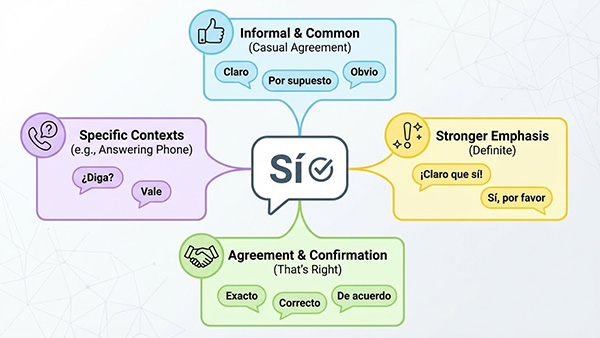
In Spanish, the word for “yes” is sí. However, expressing agreement in Spanish extends beyond this single word. For learners asking what is yes in Spanish, the answer is straightforward: the primary word is sí, which directly translates to “yes” in English. In terms of yes meaning in Spanish, sí functions as an affirmative response that signals agreement, confirmation, or consent. Its role closely mirrors how “yes” is used in English, but Spanish relies more heavily on context and tone to shape meaning. Depending on the context and the level of formality, you can use various phrases and expressions to convey affirmation. These expressions can range from a simple acknowledgment to an enthusiastic agreement.
The function of “yes” in Spanish, like in English, is to express affirmation, agreement, or consent. It can be used to answer questions, confirm statements, grant permission, or indicate acceptance.
Understanding the nuances of different affirmative expressions is essential for effective communication.
Context is key when choosing the right way to say “yes” in Spanish. The formality of the situation, your relationship with the speaker, and the specific question being asked all influence your choice of expression. For example, a casual conversation with a friend might call for a simple sí or vale, while a formal business meeting might require a more formal afirmativo or de acuerdo.
Young Adults & Students:
Get 6 Months of Prime for $0

Ages 18-24 unlock exclusive perks including:
Contains affiliate link
Structural Breakdown
The structure of affirmative responses in Spanish is generally straightforward. The basic affirmative word, sí, can stand alone as a complete response. However, it’s often accompanied by other words or phrases to add emphasis, clarity, or nuance.
For example, you might use sí, claro (“yes, of course”) to show agreement and enthusiasm. Alternatively, you could use sí, estoy de acuerdo (“yes, I agree”) to express your agreement explicitly. The structure is flexible, allowing you to tailor your response to the specific situation.
The intonation you use when saying “yes” in Spanish is also important. A simple sí can be said with a rising intonation to indicate a question or uncertainty, or with a falling intonation to indicate a firm agreement. Experimenting with different intonations can help you convey your intended meaning more effectively.
Types and Categories of “Yes” in Spanish
Sí – The Basic “Yes”
Sí is the most fundamental and widely used way to say “yes” in Spanish. It’s appropriate for almost any situation, from casual conversations to formal settings. It’s a versatile word that can be used to answer questions, confirm statements, or express agreement.
To differentiate it from the word si (if), sí always has an accent mark over the “i”. Learners often wonder about yes in Spanish spelling, especially because a small accent mark changes the meaning entirely. To clarify, how do you spell yes in Spanish correctly? The correct spelling is sí, with an accent on the “i.” Without the accent, si means “if,” which can completely alter the meaning of a sentence. This is a crucial distinction, as the meaning changes entirely without the accent.
Claro – “Of Course” or “Sure”
Claro translates to “of course” or “sure.” It implies that something is obvious or easily understood. It’s often used to express agreement in a slightly more emphatic way than a simple sí. It also conveys a sense of willingness or readiness.
Claro can also be used to acknowledge someone’s point or to show that you understand what they’re saying. In this context, it’s similar to saying “I see” or “I understand” in English.
Por Supuesto – “Of Course” or “Definitely”
Por supuesto is another way to say “of course” or “definitely.” It’s a stronger expression of agreement than claro. It indicates that you have no doubts or reservations about something. It is often used to grant permission or to express strong approval.
The phrase literally translates to “by (the) supposed,” implying that something is so obvious that it’s taken for granted. It’s a common and versatile expression in Spanish.
Desde Luego – “Of Course” or “Certainly”
Desde luego is similar to por supuesto, meaning “of course” or “certainly.” It conveys a sense of certainty and conviction. It’s often used to emphasize your agreement or to reassure someone.
The phrase literally translates to “from (the) place,” but its idiomatic meaning is closer to “naturally” or “obviously.” It’s a slightly more formal expression than por supuesto.
Vale – “Okay” or “Alright” (Spain)
Vale is a common expression in Spain that means “okay” or “alright.” It’s used to express agreement, acceptance, or understanding. It’s similar to saying “OK” in English. It is often used in casual conversations.
While vale is widely used and understood in Spain, it’s less common in Latin America. In Latin America, you might hear está bien or de acuerdo instead.
De Acuerdo – “Agreed” or “Okay”
De acuerdo means “agreed” or “okay.” It’s a more formal way to express agreement than sí or vale. It’s often used in business settings or when discussing important matters.
The phrase literally translates to “of agreement.” It indicates that you are in agreement with someone or something. It can also be used to confirm that you understand and accept a proposal or plan.
Afirmativo – “Affirmative” (Formal)
Afirmativo is a formal way to say “affirmative.” It’s typically used in professional or official contexts, such as in the military or in business communications. It’s a clear and unambiguous way to express agreement.
While afirmativo is grammatically correct and easily understood, it is not commonly used in everyday conversation. It is more suited for formal settings where precision is important.
Exacto – “Exactly”
Exacto means “exactly.” While not a direct translation of “yes,” it’s used to express agreement with a statement or idea, indicating that it’s precisely correct. It’s a strong affirmation that leaves no room for doubt.
This word can be useful when you want to emphasize that something is completely accurate or on point. It adds a layer of precision to your agreement.
Ok – “Okay” (Borrowed from English)
The word ok, borrowed directly from English, is also used in Spanish. It functions in the same way as it does in English, expressing agreement, acceptance, or understanding. Its usage has become increasingly common, especially among younger generations.
Using ok is generally considered informal. While widely understood, some purists might prefer using native Spanish alternatives like vale or está bien.
Other Ways to Express Agreement
Besides the specific words and phrases listed above, there are many other ways to express agreement in Spanish. These include:
- Desde luego que sí – “Of course, yes”
- ¡Absolutamente! – “Absolutely!”
- ¡Por supuesto que sí! – “Of course, yes!”
- ¡Claro que sí! – “Of course, yes!”
- Está bien – “It is good” or “Okay”
- Me parece bien – “It seems good to me” or “Sounds good”
- ¡De nada! – When someone thanks you, it can also be interpreted as “you’re welcome” or “yes, it was nothing”
These expressions add variety and nuance to your communication, allowing you to express agreement in a way that is appropriate for the specific situation and your personal style.
Examples in Context
Understanding how to use these different expressions in context is crucial for effective communication. The following tables provide examples of how to use each expression in various situations.
Table 1: Using Sí in Different Contexts
This table illustrates how the basic “Sí” can be used in various scenarios, showcasing its versatility and broad applicability.
| Spanish | English | Context |
|---|---|---|
| ¿Quieres café? – Sí. | Do you want coffee? – Yes. | Offering coffee |
| ¿Hablas español? – Sí, un poco. | Do you speak Spanish? – Yes, a little. | Asking about language skills |
| ¿Estás listo? – Sí, ya estoy listo. | Are you ready? – Yes, I am ready. | Asking about readiness |
| ¿Te gusta la película? – Sí, me encanta. | Do you like the movie? – Yes, I love it. | Asking about movie preferences |
| ¿Vas a venir? – Sí, voy a venir. | Are you coming? – Yes, I am coming. | Asking about attendance |
| ¿Entiendes? – Sí, entiendo. | Do you understand? – Yes, I understand. | Checking for understanding |
| ¿Es verdad? – Sí, es verdad. | Is it true? – Yes, it’s true. | Confirming a statement |
| ¿Necesitas ayuda? – Sí, por favor. | Do you need help? – Yes, please. | Offering help |
| ¿Estás cansado? – Sí, estoy muy cansado. | Are you tired? – Yes, I am very tired. | Asking about tiredness |
| ¿Quieres ir al cine? – Sí, quiero ir al cine. | Do you want to go to the movies? – Yes, I want to go to the movies. | Suggesting an activity |
| ¿Tienes hambre? – Sí, tengo mucha hambre. | Are you hungry? – Yes, I am very hungry. | Asking about hunger |
| ¿Estás de acuerdo? – Sí, estoy de acuerdo. | Do you agree? – Yes, I agree. | Asking about agreement |
| ¿Es correcto? – Sí, es correcto. | Is it correct? – Yes, it is correct. | Confirming correctness |
| ¿Estás feliz? – Sí, estoy muy feliz. | Are you happy? – Yes, I am very happy. | Asking about happiness |
| ¿Lo sabes? – Sí, lo sé. | Do you know it? – Yes, I know it. | Asking about knowledge |
| ¿Puedes ayudarme? – Sí, puedo ayudarte. | Can you help me? – Yes, I can help you. | Asking for help |
| ¿Es tuyo? – Sí, es mío. | Is it yours? – Yes, it is mine. | Asking about ownership |
| ¿Quieres bailar? – Sí, quiero bailar. | Do you want to dance? – Yes, I want to dance. | Suggesting dancing |
| ¿Estás seguro? – Sí, estoy seguro. | Are you sure? – Yes, I am sure. | Asking about certainty |
| ¿Te gusta el chocolate? – Sí, me gusta el chocolate. | Do you like chocolate? – Yes, I like chocolate. | Asking about chocolate preference |
| ¿Te gustaría venir a la fiesta? – Sí, me gustaría venir a la fiesta. | Would you like to come to the party? – Yes, I would like to come to the party. | Inviting someone to a party |
| ¿Has terminado tu trabajo? – Sí, he terminado mi trabajo. | Have you finished your work? – Yes, I have finished my work. | Asking about work completion |
| ¿Crees que va a llover? – Sí, creo que va a llover. | Do you think it will rain? – Yes, I think it will rain. | Asking about weather forecast |
Table 2: Using Claro and Por Supuesto in Different Contexts
This table compares the usage of “Claro” and “Por Supuesto,” highlighting their similarities and subtle differences in conveying agreement and certainty.
| Spanish | English | Context |
|---|---|---|
| ¿Puedo usar tu teléfono? – Claro. | Can I use your phone? – Of course. | Asking for permission |
| ¿Me puedes ayudar? – Claro que sí. | Can you help me? – Of course, yes. | Offering help |
| ¿Vas a venir a la fiesta? – Por supuesto. | Are you coming to the party? – Of course. | Asking about attendance |
| ¿Es necesario comprar pan? – Claro, es necesario. | Is it necessary to buy bread? – Of course, it’s necessary. | Confirming necessity |
| ¿Puedo entrar? – Por supuesto, adelante. | Can I come in? – Of course, come in. | Granting permission |
| ¿Entiendes la explicación? – Claro que entiendo. | Do you understand the explanation? – Of course, I understand. | Checking for understanding |
| ¿Es posible terminarlo hoy? – Por supuesto que es posible. | Is it possible to finish it today? – Of course, it is possible. | Confirming possibility |
| ¿Me acompañas al cine? – Claro, te acompaño. | Will you accompany me to the cinema? – Of course, I’ll accompany you. | Offering companionship |
| ¿Puedo tomar un poco de agua? – Por supuesto, sírvete. | Can I have some water? – Of course, help yourself. | Granting permission |
| ¿Es verdad que ganaste la lotería? – ¡Claro que es verdad! | Is it true that you won the lottery? – Of course, it’s true! | Confirming a fact |
| ¿Puedo usar tu computadora? – Claro, pero no la uses por mucho tiempo. | Can I use your computer? – Sure, but don’t use it for too long. | Asking for permission with a condition |
| ¿Puedes venir mañana? – Por supuesto, estaré aquí a las diez. | Can you come tomorrow? – Of course, I’ll be here at ten. | Confirming availability |
| ¿Es importante llegar a tiempo? – Claro, es muy importante. | Is it important to arrive on time? – Of course, it’s very important. | Emphasizing importance |
| ¿Podemos contar contigo? – Por supuesto que pueden contar conmigo. | Can we count on you? – Of course, you can count on me. | Assuring reliability |
| ¿Quieres un postre? – Claro, con gusto. | Do you want a dessert? – Of course, with pleasure. | Offering dessert |
| ¿Estás de acuerdo con mi plan? – Por supuesto, tu plan es excelente. | Do you agree with my plan? – Of course, your plan is excellent. | Expressing agreement with enthusiasm |
| ¿Necesitas que te lleve al aeropuerto? – Claro, sería de gran ayuda. | Do you need me to take you to the airport? – Of course, it would be a great help. | Offering a ride |
| ¿Crees que podemos ganar el partido? – Por supuesto, tenemos un buen equipo. | Do you think we can win the game? – Of course, we have a good team. | Expressing confidence |
Table 3: Using Vale, De Acuerdo, and Afirmativo in Different Contexts
This table showcases the varied usage of ‘Vale,’ ‘De Acuerdo,’ and ‘Afirmativo,’ highlighting their cultural context and levels of formality.
| Spanish | English | Context |
|---|---|---|
| Nos vemos mañana a las 10. – Vale. (Spain) | See you tomorrow at 10. – Okay. | Arranging a meeting (Spain) |
| ¿Estás de acuerdo con los términos? – Sí, de acuerdo. | Do you agree with the terms? – Yes, agreed. | Confirming agreement (Formal) |
| ¿Recibiste el mensaje? – Afirmativo. (Formal) | Did you receive the message? – Affirmative. | Confirming receipt (Formal) |
| ¿Vamos al bar? – Vale, vamos. (Spain) | Shall we go to the bar? – Okay, let’s go. | Suggesting an activity (Spain) |
| ¿Aprobamos el contrato? – De acuerdo. | Do we approve the contract? – Agreed. | Approving a contract (Formal) |
| ¿Confirmas la orden? – Afirmativo. (Formal) | Do you confirm the order? – Affirmative. | Confirming an order (Formal) |
| ¿Entendiste las instrucciones? – Vale, entendí. (Spain) | Did you understand the instructions? – Okay, I understood. | Confirming understanding (Spain) |
| ¿Estás de acuerdo con la propuesta? – Sí, estoy de acuerdo. | Do you agree with the proposal? – Yes, I agree. | Confirming agreement (Formal) |
| ¿Estás en posición? – Afirmativo. (Formal) | Are you in position? – Affirmative. | Confirming position (Formal) |
| Te llamo luego. – Vale. (Spain) | I’ll call you later. – Okay. | Ending a conversation (Spain) |
| ¿Aceptas los cambios? – De acuerdo, los acepto. | Do you accept the changes? – Agreed, I accept them. | Accepting changes (Formal) |
| ¿Puedes confirmar tu asistencia? – Afirmativo. (Formal) | Can you confirm your attendance? – Affirmative. | Confirming attendance (Formal) |
| ¿Quedamos a las cinco? – Vale, a las cinco. (Spain) | Shall we meet at five? – Okay, at five. | Arranging a meeting (Spain) |
| ¿Estás de acuerdo con el plan? – Sí, estoy de acuerdo con el plan. | Do you agree with the plan? – Yes, I agree with the plan. | Confirming agreement (Formal) |
| ¿Has completado la tarea? – Afirmativo. (Formal) | Have you completed the task? – Affirmative. | Confirming completion (Formal) |
| ¿Todo claro? – Vale, todo claro. (Spain) | Everything clear? – Okay, everything clear. | Checking for clarity (Spain) |
| ¿Estás de acuerdo con la decisión? – De acuerdo con la decisión. | Do you agree with the decision? – I agree with the decision. | Confirming agreement (Formal) |
| ¿Puedes confirmar que estás listo? – Afirmativo, estoy listo. (Formal) | Can you confirm that you are ready? – Affirmative, I am ready. | Confirming readiness (Formal) |
Table 4: Using Exacto in Different Contexts
This table shows the usage of ‘Exacto’ in different scenarios, emphasizing its role in confirming accuracy and precision.
| Spanish | English | Context |
|---|---|---|
| ¿Son las tres de la tarde? – ¡Exacto! | Is it three in the afternoon? – Exactly! | Confirming the time |
| ¿La capital de España es Madrid? – Exacto. | Is the capital of Spain Madrid? – Exactly. | Confirming a fact |
| ¿El resultado es 25? – ¡Exacto, ese es el resultado! | Is the result 25? – Exactly, that’s the result! | Confirming a calculation |
| ¿Es este el camino correcto? – Exacto, sigue derecho. | Is this the right way? – Exactly, go straight. | Confirming directions |
| ¿Es ella la nueva profesora? – Exacto, ella es. | Is she the new teacher? – Exactly, she is. | Confirming identity |
| ¿Es este el libro que me recomendaste? – Exacto, ese mismo. | Is this the book you recommended to me? – Exactly, that one. | Confirming a recommendation |
| ¿Necesitamos tres huevos para la receta? – Exacto, tres huevos. | Do we need three eggs for the recipe? – Exactly, three eggs. | Confirming ingredients |
| ¿El examen es el viernes? – Exacto, el viernes a las nueve. | Is the exam on Friday? – Exactly, on Friday at nine. | Confirming a date |
| ¿Debemos girar a la izquierda? – Exacto, gira a la izquierda. | Should we turn left? – Exactly, turn left. | Confirming a turn |
| ¿Es esa la casa de María? – Exacto, esa es su casa. | Is that Maria’s house? – Exactly, that’s her house. | Confirming a location |
| ¿Es importante llegar temprano? – Exacto, es crucial. | Is it important to arrive early? – Exactly, it’s crucial. | Emphasizing importance |
| ¿Este es el lugar de la reunión? – Exacto, aquí es. | Is this the meeting place? – Exactly, here it is. | Confirming a meeting place |
| ¿Es necesario firmar el documento? – Exacto, es obligatorio. | Is it necessary to sign the document? – Exactly, it’s mandatory. | Confirming a requirement |
| ¿Debemos pagar en efectivo? – Exacto, solo aceptamos efectivo. | Should we pay in cash? – Exactly, we only accept cash. | Confirming payment method |
Table 5: Using Ok in Different Contexts
This table shows the usage of ‘Ok’ in different scenarios, emphasizing its adoption from English into Spanish language.
| Spanish | English | Context |
|---|---|---|
| ¿Nos vemos a las cinco? – Ok. | Shall we meet at five? – Ok. | Arranging a meeting |
| ¿Entendiste las instrucciones? – Ok, las entendí. | Did you understand the instructions? – Ok, I understood them. | Confirming understanding |
| ¿Te parece bien este plan? – Ok, me parece bien. | Does this plan seem good to you? – Ok, it seems good to me. | Expressing agreement with a plan |
| ¿Puedes traerme el libro? – Ok, te lo traigo. | Can you bring me the book? – Ok, I’ll bring it to you. | Agreeing to a request |
| ¿Estás listo para empezar? – Ok, estoy listo. | Are you ready to start? – Ok, I’m ready. | Confirming readiness |
| ¿Te llamo mañana? – Ok, llámame mañana. | Shall I call you tomorrow? – Ok, call me tomorrow. | Arranging a phone call |
| ¿Te ayudo con esto? – Ok, gracias. | Shall I help you with this? – Ok, thanks. | Accepting help |
| ¿Quieres ir al cine? – Ok, vamos al cine. | Do you want to go to the movies? – Ok, let’s go to the movies. | Suggesting an activity |
| ¿Puedes confirmar tu asistencia? – Ok, confirmo mi asistencia. | Can you confirm your attendance? – Ok, I confirm my attendance. | Confirming attendance |
| ¿Te parece bien este horario? – Ok, me parece bien el horario. | Does this schedule seem good to you? – Ok, the schedule seems good to me. | Expressing agreement with a schedule |
Usage Rules and Considerations
While many of these expressions are interchangeable, there are some subtle differences in usage that you should be aware of. The level of formality, the region you’re in, and your personal style all play a role in choosing the right expression.
In the Spanish language, affirmative responses are more flexible than in English. While sí is the most common option, native speakers frequently rely on tone, regional preference, and context to choose alternatives. Understanding how yes functions in the Spanish language helps learners sound more natural and culturally aware.
For example, vale is primarily used in Spain, while está bien is more common in Latin America. Afirmativo is reserved for formal settings, while ok is generally considered informal. Understanding these nuances will help you communicate more effectively and avoid sounding awkward or out of place.
The tone of voice you use is also important. A simple sí can sound enthusiastic or reluctant depending on your intonation. Experiment with different tones to convey your intended meaning more accurately.
Common Mistakes to Avoid
One common mistake is confusing sí (yes) with si (if). Remember that sí always has an accent mark. Another mistake is using vale in Latin America, where it’s not as common. Using very formal expressions like afirmativo in casual conversations can also sound strange.
Here are some examples of common mistakes and their corrections:
| Incorrect | Correct | Explanation |
|---|---|---|
| Si, quiero ir. | Sí, quiero ir. | Missing accent mark on sí. |
| Vale, en Latinoamérica. | Está bien, en Latinoamérica. | Vale is less common in Latin America. |
| Afirmativo, ¿quieres café? | Sí, ¿quieres café? | Afirmativo is too formal for casual conversation. |
Practice Exercises
Test your understanding with these practice exercises. Choose the most appropriate way to say “yes” in each situation.
Exercise 1: Multiple Choice
Choose the best answer for each question.
| Question | Options | Answer |
|---|---|---|
| ¿Quieres ir al cine? | a) Si b) Vale c) Afirmativo | a) Si |
| ¿Estás de acuerdo con los términos? | a) Claro b) De acuerdo c) Ok | b) De acuerdo |
| ¿Recibiste el mensaje? (Formal) | a) Sí b) Afirmativo c) Vale | b) Afirmativo |
| ¿Nos vemos mañana a las 10? (Spain) | a) Sí b) Vale c) De acuerdo | b) Vale |
| ¿Es este el camino correcto? | a) Exacto b) Ok c) Claro | a) Exacto |
| ¿Necesitas ayuda? | a) Ok b) Si c) Por Supuesto | c) Por Supuesto |
| ¿Quieres un postre? | a) Exacto b) Claro c) Afirmativo | b) Claro |
| ¿Podemos contar contigo? | a) De acuerdo b) Por Supuesto c) Ok | b) Por Supuesto |
| ¿Entiendes la explicación? | a) Claro b) Afirmativo c) Si | a) Claro |
| ¿Es importante llegar a tiempo? | a) Exacto b) Vale c) Ok | a) Exacto |
Exercise 2: Fill in the Blanks
Fill in the blank with the most appropriate word or phrase.
| Question | Answer |
|---|---|
| ¿Puedo usar tu teléfono? – ____. | Claro |
| ¿Vas a venir a la fiesta? – ____ que sí. | Por supuesto |
| ¿Entiendes las instrucciones? – ____, las entiendo. (Spain) | Vale |
| ¿Estás de acuerdo con el plan? – ____, estoy de acuerdo. | Sí |
| ¿Confirmas la orden? – ____. (Formal) | Afirmativo |
| ¿Es ella la nueva profesora? – ____, ella es. | Exacto |
| ¿Te parece bien este horario? – ____, me parece bien. | Ok |
Advanced Topics
For advanced learners, exploring idiomatic expressions and regional variations can further enhance your understanding of how to say “yes” in Spanish. Some regions might have unique expressions or slang terms that convey agreement.
Additionally, understanding the cultural context behind certain expressions can help you use them more appropriately.
Consider researching phrases like “¡Ni hablar!” (which ironically means “no way!” but can sometimes imply a strong agreement in specific contexts) or exploring how different Spanish-speaking countries use variations of “sí” in their everyday conversations.
Frequently Asked Questions
Is there a difference between “sí” and “si”?
Yes, “sí” (with an accent) means “yes,” while “si” (without an accent) means “if.” The accent mark is crucial to distinguish between the two.
When should I use “afirmativo”?
“Afirmativo” is used in formal or professional settings, such as in the military or in business communications. It’s not common in everyday conversation.
Is “vale” used in Latin America?
While “vale” is widely understood in Latin America, it’s more commonly used in Spain. In Latin America, you might hear “está bien” or “de acuerdo” instead.
Can I use “ok” in Spanish?
Yes, the word “ok” is borrowed from English and is used in Spanish, especially among younger generations. However, it’s generally considered informal.
How can I emphasize my agreement in Spanish?
You can emphasize your agreement by using phrases like “¡Por supuesto que sí!” or “¡Claro que sí!” These expressions convey a strong sense of affirmation.
Conclusion
Mastering the art of saying “yes” in Spanish involves understanding the nuances of various expressions and using them appropriately in different contexts. From the basic sí to more formal options like afirmativo, each expression carries its own weight and conveys a specific tone. By familiarizing yourself with these expressions and practicing their usage, you can communicate more effectively and confidently in Spanish. Remember to consider the level of formality, the region you’re in, and your personal style when choosing the right expression. With practice and attention to detail, you’ll be well on your way to expressing agreement like a native speaker.

M. Thomas writes language-learning guides for EnglishScribe, covering grammar, vocabulary, and everyday expressions. Through clear explanations, practical examples, and exercises, Thomas helps ESL learners understand English and build confidence in using it.