Saying Yes in French: A Comprehensive Guide
Mastering how to say “yes” in French is fundamental to effective communication. While oui is the most well-known affirmative response, French offers a rich variety of expressions to convey agreement, enthusiasm, or confirmation.
This article will delve into the nuances of expressing affirmation in French, providing a comprehensive overview for learners of all levels. Understanding these variations will not only enhance your vocabulary but also improve your ability to engage in more natural and contextually appropriate conversations.
Whether you’re a beginner or an advanced speaker, this guide will equip you with the knowledge and practice necessary to confidently say “yes” in French.
Off to College Deals

Save up to 30% on everything you need for the semester.
Contains affiliate link
Table of Contents
- Introduction
- Definition: Saying Yes in French
- Structural Breakdown of Affirmative Responses
- Types and Categories of Affirmative Responses
- Examples of Affirmative Responses
- Usage Rules for Affirmative Responses
- Common Mistakes When Saying Yes
- Practice Exercises
- Advanced Topics in Affirmative Responses
- Frequently Asked Questions
- Conclusion
Definition: Saying Yes in French
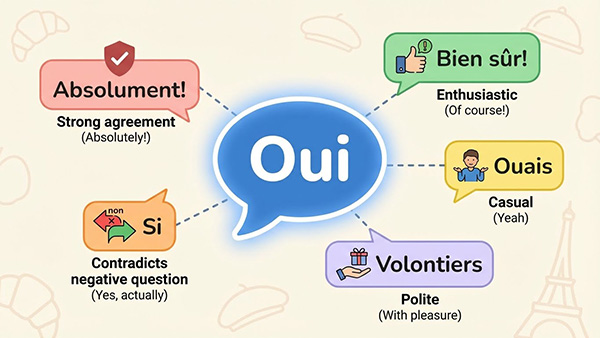
In French, expressing affirmation extends beyond a simple “yes.” The most common translation is oui, but its usage is nuanced by context, tone, and the specific question being answered.
To clarify the basics, learners often ask, “what is yes in french?” The simplest answer is oui, the standard affirmative in French. If you’re wondering “how do you say yes in french” in different contexts, you’ll find that formal, informal, emphatic, and conditional variations exist. Exploring the “yes in french language” through examples will help you understand the subtle differences between casual agreement, polite consent, and emphatic confirmation.
Additionally, “how do you say yes in french translations” highlights that sometimes English phrases like “yes, absolutely” translate into French as tout à fait or bien sûr, depending on tone and formality.
Affirmative responses can range from formal agreement to casual acknowledgment, and even emphatic confirmation. The choice of words depends on the relationship between speakers, the situation, and the degree of conviction one wishes to convey.
Young Adults & Students:
Get 6 Months of Prime for $0

Ages 18-24 unlock exclusive perks including:
Contains affiliate link
French affirmative responses are classified by their level of formality, intensity, and specificity. Formally, one might use certainement or absolument. Informally, alternatives like ouais or d’accord are common. Emphatic affirmations, such as tout à fait or exactement, underscore strong agreement. Furthermore, responses can be conditional, acknowledging a situation with a caveat, such as oui, mais… (yes, but…). Understanding these classifications enables more precise and appropriate communication.
The function of affirmative responses in French is to confirm, agree, accept, or acknowledge a statement or request. These responses serve as essential building blocks for conversations, negotiations, and social interactions.
The context dictates which affirmative response is most appropriate. For instance, a formal business setting would require different language than a casual conversation with friends.
Proper usage of these affirmative responses enhances clarity, avoids misunderstandings, and demonstrates respect for the nuances of the French language and culture.
Structural Breakdown of Affirmative Responses
The structure of affirmative responses in French is relatively straightforward, but understanding the nuances can greatly improve fluency. The simplest structure is the single word oui. However, more complex responses often involve adverbs or phrases that modify or emphasize the affirmation. These additions can alter the tone and meaning of the response.
Affirmative responses can be combined with other elements to add specificity. For example, adding bien sûr (of course) to oui creates oui, bien sûr, which expresses enthusiasm or certainty. Negative questions also influence the structure of the response. In French, answering a negative question requires careful consideration; si is used to contradict a negative statement, while non confirms it. The structure of the response thus varies depending on the question’s formulation.
Furthermore, intonation plays a crucial role in conveying meaning. A simple oui can sound skeptical, indifferent, or enthusiastic depending on the tone of voice. Rising intonation can indicate a question or uncertainty, while a firm, declarative tone conveys conviction. Mastering the structural components and intonational cues of affirmative responses is essential for clear and effective communication in French.
Types and Categories of Affirmative Responses
French offers a variety of ways to say “yes,” each with its own nuance and level of formality. Understanding these categories will help you choose the most appropriate response in different situations.
Formal Affirmation
Formal affirmations are used in professional settings, when addressing superiors, or when speaking to someone you don’t know well. These expressions convey respect and politeness.
Examples of formal affirmations include: certainement (certainly), absolument (absolutely), effectivement (indeed), tout à fait (exactly), and avec plaisir (with pleasure). These terms are suitable for business meetings, formal correspondence, and interactions with authority figures.
Informal Affirmation
Informal affirmations are appropriate for casual conversations with friends, family, and acquaintances. These expressions are more relaxed and colloquial.
Examples of informal affirmations include: ouais (yeah), d’accord (okay), OK (OK), ça marche (that works), and pas de problème (no problem). These terms are commonly used in everyday conversations and informal settings.
Emphatic Affirmation
Emphatic affirmations are used to express strong agreement or enthusiasm. These expressions convey conviction and certainty.
Examples of emphatic affirmations include: bien sûr (of course), évidemment (obviously), exactement (exactly), précisément (precisely), and volontiers (gladly). These terms are used to underscore your agreement and convey enthusiasm.
Conditional Affirmation
Conditional affirmations are used to express agreement with reservations or conditions. These expressions acknowledge the statement but introduce a caveat.
Examples of conditional affirmations include: oui, mais… (yes, but…), d’accord, mais… (okay, but…), peut-être (maybe), si possible (if possible), and en principe, oui (in principle, yes). These terms allow you to express agreement while also expressing concerns or limitations.
Examples of Affirmative Responses
Understanding how to use different affirmative responses in context is crucial. The following tables provide examples of various affirmative responses in different scenarios.
General Affirmation Examples
This table presents general examples of saying “yes” in French, covering a range of formality levels and contexts. Use these examples to understand how the same affirmative meaning can be expressed in diverse ways.
| French | English Translation | Context |
|---|---|---|
| Oui. | Yes. | General affirmation in any context. |
| Si. | Yes (in response to a negative question). | Answering a negative question affirmatively. |
| Ouais. | Yeah. | Informal affirmation among friends. |
| D’accord. | Okay. | Agreement or acceptance. |
| Bien sûr. | Of course. | Expressing certainty or agreement. |
| Absolument. | Absolutely. | Strong agreement. |
| Certainement. | Certainly. | Formal agreement. |
| Évidemment. | Obviously. | Expressing something is clear. |
| Exactement. | Exactly. | Expressing precise agreement. |
| Volontiers. | Gladly. | Accepting an offer with pleasure. |
| Avec plaisir. | With pleasure. | Accepting an invitation or request. |
| Pas de problème. | No problem. | Agreeing to do something easily. |
| Ça marche. | That works. | Confirming a plan. |
| OK. | OK. | Informal agreement, borrowed from English. |
| Très bien. | Very well. | Agreeing to something formally. |
| Tout à fait. | Exactly. | Strong agreement with a statement. |
| Effectivement. | Indeed. | Confirming a fact. |
| Précisément. | Precisely. | Agreeing with accuracy. |
| Pourquoi pas ? | Why not? | Expressing willingness. |
| Sans doute. | Without a doubt. | Expressing certainty. |
| Je suis d’accord. | I agree. | Expressing personal agreement. |
| Je veux bien. | I’d like to. | Expressing willingness to do something. |
| C’est entendu. | It’s agreed. | Confirming an agreement. |
| D’accord, d’accord. | Okay, okay. | Expressing quick agreement. |
| Oui, je comprends. | Yes, I understand. | Expressing understanding. |
| Oui, c’est ça. | Yes, that’s it. | Confirming something is correct. |
Formal Affirmation Examples
This table illustrates the use of formal affirmative responses in professional or respectful contexts. Using these phrases correctly demonstrates cultural sensitivity and professionalism.
| French | English Translation | Context |
|---|---|---|
| Certainement, Monsieur/Madame. | Certainly, Sir/Madam. | Answering a superior in a formal setting. |
| Absolument, nous serons là. | Absolutely, we will be there. | Confirming attendance at a formal event. |
| Effectivement, c’est le cas. | Indeed, that is the case. | Confirming a fact in a business meeting. |
| Tout à fait, je suis d’accord. | Exactly, I agree. | Showing agreement in a formal discussion. |
| Avec plaisir, je vais vous aider. | With pleasure, I will help you. | Offering assistance politely. |
| Très bien, nous allons procéder. | Very well, we will proceed. | Agreeing to move forward with a plan formally. |
| Je suis tout à fait d’accord avec vous. | I completely agree with you. | Expressing strong agreement in a formal setting. |
| Bien entendu, nous suivrons vos instructions. | Of course, we will follow your instructions. | Assuring someone you will comply formally. |
| Sans aucun doute, c’est une bonne idée. | Without a doubt, it’s a good idea. | Expressing certainty about an idea formally. |
| Je confirme, la réunion est à 10 heures. | I confirm, the meeting is at 10 o’clock. | Confirming details in a professional context. |
| Je suis ravi(e) de vous aider. | I am delighted to help you. | Offering help in a polite and formal manner. |
| Nous serons ravis de vous accueillir. | We will be delighted to welcome you. | Extending a formal invitation. |
| Je suis entièrement d’accord avec votre proposition. | I completely agree with your proposal. | Formally agreeing with a suggestion. |
| Je suis tout à fait favorable à cette idée. | I am entirely in favor of this idea. | Expressing formal support for an idea. |
| Nous sommes d’accord sur ce point. | We agree on this point. | Formally agreeing on a specific issue. |
| Nous approuvons votre demande. | We approve your request. | Formally approving a request. |
| Je souscris entièrement à votre avis. | I entirely subscribe to your opinion. | Formally agreeing with an opinion. |
| Nous sommes tout à fait en accord avec cette décision. | We are completely in agreement with this decision. | Formally agreeing with a decision. |
| Je suis tout à fait d’accord avec cette politique. | I completely agree with this policy. | Formally agreeing with a policy. |
| Nous sommes ravis de collaborer avec vous. | We are delighted to collaborate with you. | Expressing formal enthusiasm for collaboration. |
Informal Affirmation Examples
This table provides examples of informal ways to say “yes” in French. These expressions are suitable for conversations with friends and family.
| French | English Translation | Context |
|---|---|---|
| Ouais, ça va. | Yeah, it’s okay. | Responding casually to “How’s it going?” |
| D’accord, on y va. | Okay, let’s go. | Agreeing to leave with friends. |
| OK, pas de problème. | OK, no problem. | Agreeing to help a friend. |
| Ça marche, à plus. | That works, see you later. | Confirming a plan and saying goodbye. |
| Ouais, je suis partant. | Yeah, I’m in. | Agreeing to join an activity. |
| D’ac. | Okay (shortened). | Very informal agreement via text. |
| Carrément! | Totally! | Expressing enthusiastic agreement. |
| Nickel! | Perfect! | Agreeing something is perfect or great. |
| C’est bon! | It’s good! | Agreeing that something is acceptable. |
| Bof, d’accord. | Meh, okay. | Reluctantly agreeing. |
| Si tu veux. | If you want. | Indifferent agreement. |
| Pourquoi pas! | Why not! | Expressing willingness to try something. |
| Je suis chaud(e)! | I’m up for it! | Expressing enthusiasm for an activity. |
| À la cool! | Cool! | Agreeing to do something in a relaxed way. |
| Sans problème! | No problem! | Agreeing easily. |
| Ça roule! | It rolls! (It works!) | Confirming a plan informally. |
| C’est parti! | Let’s go! | Agreeing to start an activity. |
| Vas-y! | Go for it! | Encouraging someone. |
| Banco! | Jackpot! | Expressing enthusiastic agreement. |
| Yes! | Yes! | Borrowed from English, used informally. |
| D’accord, mon pote. | Okay, my buddy. | Agreeing with a friend. |
| Ouais, grave! | Yeah, seriously! | Expressing strong agreement. |
| Carrément d’accord! | Totally agree! | Expressing enthusiastic agreement. |
| C’est clair! | It’s clear! | Expressing obvious agreement. |
| J’avoue! | I admit! | Agreeing with something reluctantly. |
Sometimes, you want to express not just agreement but that something is perfectly right. In French, the phrase “yes perfect in french” can be conveyed in several ways. Informally, you can say nickel!, which literally means “perfect” or “spot on.” For slightly more formal contexts, parfait! works perfectly to affirm that something meets expectations exactly. Using these expressions adds nuance to your conversations and ensures your agreement communicates the right level of enthusiasm or precision.
Emphatic Affirmation Examples
This table showcases examples of emphatic affirmative responses in French. Use these to express strong agreement or certainty.
| French | English Translation | Context |
|---|---|---|
| Bien sûr que oui! | Of course, yes! | Emphasizing agreement with enthusiasm. |
| Évidemment que c’est vrai! | Obviously, it’s true! | Emphasizing the obviousness of a truth. |
| Exactement ce que je pensais! | Exactly what I was thinking! | Expressing perfect agreement. |
| Précisément, c’est le point crucial. | Precisely, that’s the crucial point. | Highlighting the accuracy of a statement. |
| Volontiers, avec grand plaisir! | Gladly, with great pleasure! | Accepting an offer enthusiastically. |
| Absolument, sans hésitation! | Absolutely, without hesitation! | Expressing strong and immediate agreement. |
| Certainement, je vous le garantis! | Certainly, I guarantee it to you! | Assuring someone emphatically. |
| Tout à fait, je suis entièrement d’accord! | Exactly, I completely agree! | Expressing full and strong agreement. |
| Mais oui, enfin! | But yes, finally! | Expressing impatience and agreement. |
| Oui, mille fois oui! | Yes, a thousand times yes! | Expressing overwhelming agreement. |
| Évidemment, c’est une évidence! | Obviously, it’s obvious! | Emphasizing the clarity of something. |
| Précisément, vous avez tout compris! | Precisely, you understood everything! | Acknowledging someone’s perfect understanding. |
| Volontiers, c’est une excellente idée! | Gladly, it’s an excellent idea! | Expressing enthusiasm for a suggestion. |
| Absolument, je suis convaincu(e)! | Absolutely, I am convinced! | Expressing strong conviction. |
| Certainement, vous pouvez compter sur moi! | Certainly, you can count on me! | Offering reliable support. |
| Tout à fait, c’est exactement ça! | Exactly, that’s exactly it! | Confirming something perfectly. |
| Mais oui, bien sûr que oui! | But yes, of course yes! | Emphasizing the obviousness of an agreement. |
| Oui, plus que oui! | Yes, more than yes! | Expressing extreme agreement. |
| Évidemment, c’est la seule solution! | Obviously, it’s the only solution! | Emphasizing the necessity of something. |
| Précisément, vous avez mis le doigt dessus! | Precisely, you hit the nail on the head! | Acknowledging someone’s accurate insight. |
Conditional Affirmation Examples
This table illustrates the use of conditional affirmative responses. These are useful when you agree but have reservations or conditions.
| French | English Translation | Context |
|---|---|---|
| Oui, mais c’est compliqué. | Yes, but it’s complicated. | Agreeing with a reservation. |
| D’accord, mais à condition que… | Okay, but on the condition that… | Agreeing with a specific condition. |
| Peut-être, on verra. | Maybe, we’ll see. | Expressing tentative agreement. |
| Si possible, j’aimerais bien. | If possible, I would like to. | Expressing agreement with a possibility. |
| En principe, oui, mais… | In principle, yes, but… | Agreeing in principle but with concerns. |
| Oui, si tu m’aides. | Yes, if you help me. | Agreeing with a condition of mutual help. |
| D’accord, mais à quel prix ? | Okay, but at what cost? | Agreeing but questioning the consequences. |
| Peut-être, si j’ai le temps. | Maybe, if I have time. | Agreeing based on availability. |
| En théorie, oui. | In theory, yes. | Agreeing in theory but doubting practicality. |
| Oui, à condition que ce soit rapide. | Yes, provided it’s quick. | Agreeing with a time constraint. |
| D’accord, mais je ne suis pas sûr(e). | Okay, but I’m not sure. | Agreeing with uncertainty. |
| Peut-être, si les conditions sont favorables. | Maybe, if the conditions are favorable. | Agreeing based on external factors. |
| En principe, oui, mais il faut voir. | In principle, yes, but we need to see. | Agreeing but requiring further evaluation. |
| Oui, si cela ne prend pas trop de temps. | Yes, if it doesn’t take too much time. | Agreeing with a time constraint. |
| D’accord, mais sous certaines réserves. | Okay, but with certain reservations. | Agreeing with specific reservations. |
| Peut-être, si je suis motivé(e). | Maybe, if I’m motivated. | Agreeing based on personal motivation. |
| En principe, oui, mais je dois vérifier. | In principle, yes, but I need to verify. | Agreeing but requiring verification. |
| Oui, si tout se passe comme prévu. | Yes, if everything goes as planned. | Agreeing based on expected outcomes. |
| D’accord, mais à vos risques et périls. | Okay, but at your own risk. | Agreeing with a warning of potential risks. |
| Peut-être, si je suis en forme. | Maybe, if I’m in good shape. | Agreeing based on personal condition. |
Usage Rules for Affirmative Responses
Using affirmative responses correctly depends on several factors, including formality, context, and the type of question being answered. Here are some key rules to keep in mind:
- Formality: Choose formal affirmations (certainement, absolument) in professional or respectful settings. Use informal affirmations (ouais, d’accord) with friends and family.
- Answering Negative Questions: Use si to contradict a negative statement. For example, if someone asks, “Tu n’aimes pas le chocolat?” (You don’t like chocolate?), you would respond with si if you do like chocolate. Use non to confirm the negative statement.
- Emphasis: Use emphatic affirmations (bien sûr, exactement) to express strong agreement or enthusiasm.
- Conditions: Use conditional affirmations (oui, mais…) to express agreement with reservations or conditions.
- Intonation: Pay attention to your tone of voice. A simple oui can convey different meanings depending on your intonation.
There are also some exceptions to these rules. For example, while OK is generally considered informal, it can be used in some professional settings, especially in international contexts. Additionally, some regions of France may have their own unique affirmative expressions. Being aware of these nuances will help you communicate more effectively.
Common Mistakes When Saying Yes
Even experienced learners can make mistakes when using affirmative responses in French. Here are some common errors to avoid:
| Incorrect | Correct | Explanation |
|---|---|---|
| Oui, je ne suis pas d’accord. | Non, je ne suis pas d’accord. | Using oui when disagreeing. |
| Si, je suis d’accord. | Oui, je suis d’accord. | Using si when agreeing with a positive statement. |
| Absolument, mon ami. | Absolument, Monsieur/Madame. (in formal settings) D’accord, mon ami. (in informal settings) | Using formal language in an informal context or vice versa. |
| Responding to “Tu n’as pas faim?” (Aren’t you hungry?) with oui when you are hungry. | Responding to “Tu n’as pas faim?” with si when you are hungry. | Incorrect use of oui in response to a negative question when you want to contradict it. |
| Je suis oui. | Je suis d’accord. | Incorrectly translating “I am yes.” |
Avoiding these common mistakes will help you communicate more accurately and confidently in French. Always consider the context and formality of the situation when choosing your affirmative response.
Practice Exercises
Test your understanding of affirmative responses in French with these practice exercises.
- Question: Tu aimes le café? (Do you like coffee?)Answer Choices: a) Oui, b) Non, c) Si
Correct Answer: a) Oui
- Question: Tu n’aimes pas les maths? (You don’t like math?)Answer Choices: a) Oui, b) Non, c) Si (if you do like math)
Correct Answer: c) Si (if you do like math)
- Question: On va au cinéma? (Shall we go to the cinema?)Answer Choices: a) D’accord, b) Non, c) Peut-être
Correct Answer: a) D’accord (if you agree)
- Question: Vous êtes prêt pour la réunion? (Are you ready for the meeting?)Answer Choices: a) Ouais, b) Certainement, c) Si
Correct Answer: b) Certainement (in a formal setting)
- Question: Tu peux m’aider? (Can you help me?)Answer Choices: a) Pas de problème, b) Non, c) Si
Correct Answer: a) Pas de problème
- Question: Tu es d’accord avec moi? (Do you agree with me?)Answer Choices: a) Oui, b) Non, c) Exactement
Correct Answer: c) Exactement (if you strongly agree)
- Question: Tu veux venir avec nous? (Do you want to come with us?)Answer Choices: a) Volontiers, b) Non, c) Si
Correct Answer: a) Volontiers (if you accept with pleasure)
- Question: Tu n’as pas de frères et sœurs? (You don’t have any siblings?)Answer Choices: a) Oui, b) Non (if you don’t have siblings), c) Si (if you do have siblings)
Correct Answer: b) Non (if you don’t have siblings), c) Si (if you do have siblings)
- Question: Ça te dit d’aller au restaurant? (Do you feel like going to the restaurant?)Answer Choices: a) Ça marche, b) Non, c) Si
Correct Answer: a) Ça marche (if you agree)
- Question: Tu es fatigué? (Are you tired?)Answer Choices: a) Oui, b) Non, c) Peut-être
Correct Answer: a) Oui (if you are tired) or c) Peut-être (if you are unsure)
Here is another practice exercise in table format.
| Question | Answer Choices | Correct Answer |
|---|---|---|
| Tu aimes le sport? (Do you like sports?) | a) Oui,b) Non, c) Si | a) Oui |
| Tu n’as pas de voiture? (You don’t have a car?) | a) Oui, b) Non, c) Si | b) Non (if you don’t have a car), c) Si (if you do have a car) |
| On prend un café? (Shall we have a coffee?) | a) D’accord, b) Non, c) Peut-être | a) D’accord |
| Êtes-vous disponible demain? (Are you available tomorrow?) | a) Certainement, b) Ouais, c) Si | a) Certainement |
| Tu veux venir à la fête? (Do you want to come to the party?) | a) Volontiers, b) Non, c) Si | a) Volontiers |
Advanced Topics in Affirmative Responses
For advanced learners, understanding the subtleties of affirmative responses can further enhance communication skills. This includes mastering regional variations, idiomatic expressions, and the use of affirmative responses in complex sentence structures.
In some regions of France, different affirmative expressions are preferred. For example, in certain areas, ben oui is a common way to say “yes.” Additionally, idiomatic expressions can add color and nuance to your responses. For example, saying c’est dans la poche (it’s in the bag) is an affirmative way of saying something is assured or guaranteed.
Furthermore, affirmative responses can be integrated into more complex sentence structures to convey agreement while adding additional information or context. For example, you might say, Oui, et en plus… (Yes, and what’s more…) to add another point to your agreement. These advanced topics will help you refine your use of affirmative responses and communicate with greater sophistication.
Frequently Asked Questions
When should I use si instead of oui?
Use si to contradict a negative question or statement. For example, if someone asks, “Tu n’aimes pas le vin?” (You don’t like wine?), you would answer si if you do like wine.
What is the most formal way to say “yes” in French?
The most formal ways to say “yes” in French are certainement and absolument. These expressions are appropriate for professional settings or when speaking to someone you don’t know well.
How can I express strong agreement in French?
To express strong agreement, you can use emphatic affirmations such as bien sûr, évidemment, or exactement.
Is it okay to use OK in French?
Yes, OK is commonly used in French, especially in informal settings. However, it’s generally better to use French alternatives like d’accord in more formal situations.
What does ça marche mean?
Ça marche means “that works” or “okay.” It’s an informal way to agree to a plan or suggestion.
How do I say “yes, but…” in French?
To say “yes, but…” in French, use oui, mais… or d’accord, mais…. This allows you to express agreement while also expressing concerns or limitations.
What are some informal ways to say yes?
Some informal ways to say yes include ouais, d’ac, carrément, and nickel. These are appropriate for casual conversations with friends and family.
How do I express enthusiasm when saying yes?
To express enthusiasm, use phrases like volontiers, avec plaisir, or bien sûr que oui!.
Can the tone of voice change the meaning of “oui”?
Yes, the tone of voice can significantly change the meaning of oui. A flat oui can sound indifferent, while an enthusiastic oui conveys excitement. Practice varying your intonation to match your intended meaning.
How can I avoid sounding rude when saying “no” in French?
While this article focuses on saying “yes,” it’s important to politely decline in certain situations. You can soften a “no” by using phrases like “Je suis désolé(e), mais…” (I’m sorry, but…) or “Ce n’est pas possible pour moi, mais…” (It’s not possible for me, but…).
Conclusion
Mastering affirmative responses in French is essential for effective communication. While oui is the fundamental “yes,” understanding the nuances of formality, emphasis, and conditional agreement will significantly enhance your fluency.
By practicing the various expressions and usage rules outlined in this guide, you’ll be well-equipped to navigate a wide range of conversations and express yourself with confidence and precision. Remember to consider the context, your relationship with the speaker, and the specific question being asked to choose the most appropriate affirmative response. Keep practicing, and you’ll soon find yourself saying “yes” like a native!

M. Thomas writes language-learning guides for EnglishScribe, covering grammar, vocabulary, and everyday expressions. Through clear explanations, practical examples, and exercises, Thomas helps ESL learners understand English and build confidence in using it.