Winter Adjectives: Describing the Season of Snow and Ice
Winter, with its unique beauty and challenges, offers a rich tapestry of experiences. To truly capture the essence of this season in writing or conversation, a strong command of descriptive adjectives is essential.
This article provides a comprehensive guide to using adjectives effectively to depict winter scenes, feelings, and phenomena. Whether you’re a student, writer, or simply an English language enthusiast, this resource will enhance your vocabulary and improve your descriptive abilities.
We will explore a wide range of adjectives, providing examples and practice exercises to help you master their usage. By the end of this article, you’ll be able to paint vivid winter landscapes with words.
Off to College Deals

Save up to 30% on everything you need for the semester.
Contains affiliate link
This guide is tailored for learners of all levels, from beginner to advanced. We’ll begin with fundamental definitions and progress to more nuanced applications, ensuring that everyone can benefit.
Dive in and discover the power of language to bring the winter season to life!
Table of Contents
- Definition of Adjectives for Winter
- Structural Breakdown of Winter Adjectives
- Types and Categories of Winter Adjectives
- Examples of Winter Adjectives
- Usage Rules for Winter Adjectives
- Common Mistakes with Winter Adjectives
- Practice Exercises
- Advanced Topics: Nuances and Figurative Language
- Frequently Asked Questions
- Conclusion
Definition of Adjectives for Winter
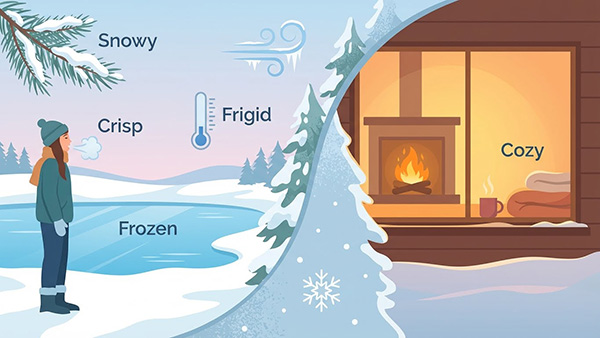
An adjective is a word that modifies a noun or pronoun, providing more information about it. Adjectives answer questions like “What kind?”, “Which one?”, “How many?”, or “How much?”. In the context of winter, adjectives help us describe the various aspects of the season, from its visual characteristics to the feelings it evokes.
Winter adjectives can be classified based on their function. Descriptive adjectives paint a picture of the winter landscape, while feeling adjectives convey the emotions associated with the season. Weather adjectives describe the specific conditions, and temperature adjectives indicate the degree of cold. Finally, appearance adjectives focus on how things look during winter.
Young Adults & Students:
Get 6 Months of Prime for $0

Ages 18-24 unlock exclusive perks including:
Contains affiliate link
Understanding the different types of adjectives and how they function is crucial for effective communication. By using a variety of adjectives, you can create vivid and engaging descriptions of winter experiences. For example, instead of simply saying “It was cold,” you could say “It was a bitterly cold day,” adding depth and detail to your statement.
When learning how to describe winter, using the right adjectives to describe winter can make your writing vivid and engaging. Consider descriptive words that capture temperature, weather, and atmosphere, such as “frigid,” “snowy,” or “wintry.” You might wonder, how can you describe winter in terms of feelings or activities? Adjectives for winter can express both mood and environment, for example, “cozy,” “bleak,” or “glittering.” Some learners also ask, is winter a adjective? While “winter” is primarily a noun, it can function adjectivally in phrases like “winter day” or “winter landscape,” allowing you to modify another noun effectively.
Structural Breakdown of Winter Adjectives
Adjectives typically precede the noun they modify (attributive position), but they can also follow a linking verb (predicative position). For example, in the phrase “snowy mountains,” the adjective “snowy” comes before the noun “mountains.” In the sentence “The day was frosty,” the adjective “frosty” follows the linking verb “was.”
Many winter adjectives can be formed by adding suffixes like “-y,” “-ful,” “-less,” or “-ic” to nouns or verbs. For example, “snow” becomes “snowy,” “frost” becomes “frosty,” and “ice” becomes “icy.” Some adjectives are inherently descriptive and don’t follow a specific pattern, such as “cold,” “bleak,” or “crisp.”
Adjectives can also be modified by adverbs to intensify or soften their meaning. For instance, “very cold” is more intense than “cold,” and “slightly frosty” is less intense than “frosty.” Using adverbs effectively can add further nuance to your descriptions.
Types and Categories of Winter Adjectives
Winter adjectives can be grouped into several categories based on what they describe. Let’s explore each category in detail.
Descriptive Adjectives
Descriptive adjectives paint a picture of the winter landscape. They focus on the visual and sensory aspects of the season.
These can describe the appearance of snow, ice, trees, and the overall environment.
For winter activities like skiing, adjectives to help describe skiing are essential for capturing both the environment and the experience. Words like “powdery,” “snow-laden,” or “pristine” describe the snow conditions, while “invigorating,” “bracing,” or “thrilling” convey the sensation of skiing. Incorporating adjectives to help describe skiing enriches your writing and allows readers to visualize and feel the activity more vividly.
Examples of descriptive adjectives include: snowy, icy, frosty, bleak, crisp, white, frozen, windswept, glittering, shimmering, desolate, barren, silent.
Adjectives Describing Feelings
These adjectives describe the emotions and sensations associated with winter. They capture the feelings that the season evokes, such as joy, sadness, or peace.
Examples of feeling adjectives include: cozy, peaceful, serene, melancholy, invigorating, bracing, comforting, isolated, reflective, nostalgic, dreary, oppressive.
Adjectives Describing Weather
Weather adjectives describe the specific weather conditions during winter. They provide information about the type of precipitation, wind, and overall atmospheric conditions.
Examples of weather adjectives include: snowy, icy, blizzardous, stormy, hailing, sleeting, windy, gusty, freezing, drizzly, overcast, cloudy.
Adjectives Describing Temperature
These adjectives describe the degree of cold during winter, ranging from mildly chilly to extremely frigid.
Examples of temperature adjectives include: cold, chilly, freezing, frigid, bitter, icy, frosty, perishing, nippy, arctic, subzero, glacial.
Adjectives Describing Appearance
Appearance adjectives focus on the visual characteristics of objects and landscapes during winter. They describe how things look under winter conditions.
Examples of appearance adjectives include: white, silver, crystal, sparkling, glistening, frosted, snow-covered, ice-covered, bare, dormant, wintry, frozen.
Examples of Winter Adjectives
Let’s delve into specific examples of how these adjectives can be used in sentences. We’ll organize the examples by category for clarity.
Descriptive Adjective Examples
The following table provides examples of descriptive adjectives used in sentences.
| Adjective | Example Sentence |
|---|---|
| Snowy | The snowy landscape was breathtaking. |
| Icy | The roads were icy and dangerous. |
| Frosty | A frosty mist hung in the air. |
| Bleak | The bleak winter sky made me feel somber. |
| Crisp | The air was crisp and refreshing. |
| White | A white blanket of snow covered the fields. |
| Frozen | The frozen lake was perfect for skating. |
| Windswept | The windswept plains felt desolate. |
| Glittering | The glittering snow sparkled in the sunlight. |
| Shimmering | The shimmering ice looked like diamonds. |
| Desolate | The desolate winter landscape stretched for miles. |
| Barren | The barren trees stood stark against the sky. |
| Silent | The silent forest was peaceful and still. |
| Chilling | The chilling wind cut right through my coat. |
| Dazzling | The dazzling snow reflected the sun’s rays. |
| Bitter | The bitter cold made my cheeks numb. |
| Frozen | The frozen waterfall was a sight to behold. |
| Icy | An icy glaze covered the branches of the trees. |
| Snow-laden | The snow-laden boughs of the pine trees drooped low. |
| White-clad | The village was white-clad after the heavy snowfall. |
| Pristine | The pristine snow was untouched and pure. |
| Powdery | The powdery snow was perfect for skiing. |
Feeling Adjective Examples
The following table shows examples of feeling adjectives used in sentences to describe emotions and sensations associated with winter.
| Adjective | Example Sentence |
|---|---|
| Cozy | The cozy cabin was a welcome retreat from the cold. |
| Peaceful | The peaceful winter landscape calmed my mind. |
| Serene | The serene silence of the snow-covered forest was soothing. |
| Melancholy | The melancholy grey skies made me feel thoughtful. |
| Invigorating | The invigorating cold air woke me up. |
| Bracing | The bracing wind made me feel alive. |
| Comforting | The comforting warmth of the fire was delightful. |
| Isolated | I felt isolated in the snow-covered mountains. |
| Reflective | The quiet winter days made me feel reflective. |
| Nostalgic | The smell of woodsmoke made me feel nostalgic. |
| Dreary | The dreary weather made me want to stay inside. |
| Oppressive | The oppressive cold weighed heavily on me. |
| Cheerful | The cheerful holiday lights brightened the winter night. |
| Festive | The festive atmosphere of the Christmas market was joyful. |
| Gloomy | The gloomy weather matched my mood. |
| Tranquil | The tranquil winter scene was incredibly calming. |
| Hushed | A hushed stillness fell over the land after the snowfall. |
| Enchanting | The enchanting winter wonderland felt magical. |
| Eerie | An eerie silence descended during the snowstorm. |
| Lonely | The lonely cabin stood solitary in the winter landscape. |
| Grim | The grim reality of the harsh winter was evident. |
| Forlorn | The forlorn trees stood bare against the sky. |
Weather Adjective Examples
This table provides examples of weather adjectives in use.
| Adjective | Example Sentence |
|---|---|
| Snowy | It was a snowy day, perfect for sledding. |
| Icy | The icy conditions made driving dangerous. |
| Blizzardous | The blizzardous storm shut down the city. |
| Stormy | The stormy weather kept us indoors. |
| Hailing | It was hailing heavily, covering the ground in ice. |
| Sleeting | The sleeting rain made the roads slippery. |
| Windy | The windy weather made it feel even colder. |
| Gusty | The gusty winds howled through the trees. |
| Freezing | The freezing rain turned to ice on contact. |
| Drizzly | A drizzly rain fell all day. |
| Overcast | The sky was overcast and grey. |
| Cloudy | It was a cloudy and dull winter day. |
| Frosted | The frosted windows showed beautiful patterns. |
| Chilly | The chilly breeze made me shiver. |
| Snowbound | We were snowbound in our cabin. |
| Blustery | A blustery wind shook the trees. |
| Frigid | The frigid temperatures were unbearable. |
| Severe | The severe winter weather caused many accidents. |
| Harsh | The harsh winter conditions tested their resilience. |
| Inclement | The inclement weather made travel impossible. |
| Raw | The raw chill in the air bit at our faces. |
| Tempestuous | A tempestuous storm raged outside. |
Temperature Adjective Examples
The following table lists examples of adjectives used to describe temperature.
| Adjective | Example Sentence |
|---|---|
| Cold | It was a cold winter morning. |
| Chilly | The air was chilly, so I wore a sweater. |
| Freezing | The water was freezing. |
| Frigid | The frigid temperatures made it hard to stay warm. |
| Bitter | The bitter cold stung my skin. |
| Icy | An icy wind blew through the streets. |
| Frosty | It was a frosty night. |
| Perishing | I was perishing with cold. |
| Nippy | It was a nippy evening. |
| Arctic | The weather was arctic. |
| Subzero | The temperatures were subzero. |
| Glacial | A glacial wind swept across the plains. |
| Brisk | The brisk air invigorated me. |
| Freezing | The freezing temperatures caused pipes to burst. |
| Gelid | The gelid wind cut through our coats. |
| Icy-cold | An icy-cold breeze swept across the lake. |
| Numbing | The numbing cold made my fingers ache. |
| Piercing | A piercing wind blew off the mountains. |
| Shivering | The shivering cold made my teeth chatter. |
| Wintry | The wintry weather made us want to stay indoors. |
| Chilling | The chilling wind cut right through my layers. |
| Freezing over | The lake was freezing over in the arctic blast. |
Appearance Adjective Examples
The following table lists examples of adjectives used to describe appearance.
| Adjective | Example Sentence |
|---|---|
| White | The white snow covered everything. |
| Silver | The silver moonlight reflected off the snow. |
| Crystal | The crystal snowflakes were beautiful. |
| Sparkling | The sparkling snow glittered in the sun. |
| Glistening | The glistening ice was treacherous. |
| Frosted | The frosted windows were decorated with ice crystals. |
| Snow-covered | The snow-covered trees looked magical. |
| Ice-covered | The ice-covered branches sparkled. |
| Bare | The bare trees stood against the sky. |
| Dormant | The dormant garden waited for spring. |
| Wintry | The wintry landscape was stark and beautiful. |
| Frozen | The frozen river was still and silent. |
| Glazed | The glazed street was slippery. |
| Hoary | The hoary frost covered the fields. |
| Snow-dusted | The mountains were snow-dusted. |
| Diamond-like | The diamond-like ice crystals glittered in the sun. |
| Gleaming | The gleaming snow reflected the morning light. |
| Frozen-over | The pond was frozen-over with a thick layer of ice. |
| Iced | The iced branches shimmered in the sunlight. |
| Silvery | The silvery light of the moon illuminated the snow. |
| Snow-white | The snow-white landscape was pristine. |
| Translucent | The translucent ice revealed the dark water below. |
Usage Rules for Winter Adjectives
When using winter adjectives, remember these rules:
- Placement: Adjectives usually come before the noun they modify. Example: “The frozen lake.”
- Linking Verbs: After linking verbs (is, are, was, were, etc.), adjectives describe the subject. Example: “The day was cold.”
- Order of Adjectives: When using multiple adjectives, follow a general order: opinion, size, age, shape, color, origin, material, purpose. Example: “A beautiful, large, old, round, white, American, wooden table.”
- Compound Adjectives: Hyphenate compound adjectives that come before a noun. Example: “The snow-covered mountain.”
- Comparative and Superlative Forms: Use “-er” and “-est” for shorter adjectives, and “more” and “most” for longer adjectives to form comparative and superlative degrees. Example: “colder,” “coldest,” “more beautiful,” “most beautiful.”
It is also important to consider the context and audience when choosing adjectives. Formal writing may require more precise and sophisticated language, while informal conversation allows for more colloquial expressions.
Common Mistakes with Winter Adjectives
Here are some common mistakes to avoid when using winter adjectives:
| Incorrect | Correct | Explanation |
|---|---|---|
| The snow was very whitely. | The snow was very white. | “Whitely” is not a proper adjective. Use “white.” |
| The day was more colder. | The day was colder. | Do not use “more” with adjectives that already have the “-er” suffix. |
| The most freezing day. | The freeziest day. | “Freeziest” is accepted as a superlative adjective in informal contexts, but “most freezing” is more formal. |
| A snow covered mountain. | A snow-covered mountain. | Hyphenate compound adjectives before nouns. |
| The weather was freeze. | The weather was freezing. | “Freeze” is a verb. Use the adjective “freezing.” |
| A cold bitter day. | A bitter cold day. | The order of adjectives matters. “Bitter” is more of an opinion/observation so comes before “cold.” |
| The snow is very icyly. | The snow is very icy. | “Icyly” is an adverb; use the adjective “icy.” |
| The most chilliest day. | The chilliest day. | Avoid using both “most” and the “-est” suffix. |
| The wind was blowy. | The wind was windy. | “Windy” is the correct adjective to describe wind. |
| The ice was slip. | The ice was slippery. | “Slip” is a verb. Use the adjective “slippery.” |
Practice Exercises
Test your knowledge with these practice exercises. Fill in the blanks with appropriate winter adjectives.
| Question | Answer |
|---|---|
| 1. The _______ wind howled through the trees. | Gusty |
| 2. The _______ landscape was covered in snow. | White/Snowy |
| 3. It was a _______ cold day. | Bitter/Frigid |
| 4. The _______ silence of the forest was calming. | Peaceful/Serene |
| 5. The roads were _______ and dangerous. | Icy |
| 6. The _______ mountain was breathtaking. | Snow-covered |
| 7. A _______ mist hung in the air. | Frosty |
| 8. The _______ holiday lights brightened the night. | Cheerful/Festive |
| 9. We were _______ in our cabin during the storm. | Snowbound |
| 10. The _______ branches sparkled in the sun. | Ice-covered |
More Practice Questions:
| Question | Answer |
|---|---|
| 1. The _______ snow made the landscape look magical. | Sparkling/Glistening |
| 2. The _______ air made my cheeks burn. | Cold/Brisk |
| 3. The _______ trees stood bare against the horizon. | Barren |
| 4. The _______ lake reflected the grey sky. | Frozen |
| 5. The _______ wind cut through my coat. | Chilling |
| 6. The _______ silence was deafening. | Eerie |
| 7. The _______ ground crunched beneath my boots. | Frozen/Icy |
| 8. The _______ fire kept us warm. | Cozy |
| 9. The _______ scene was picturesque. | Wintry |
| 10. The _______ branches were laden with snow. | Snow-laden |
Advanced Practice: Rewrite the following sentences using more descriptive winter adjectives.
| Original Sentence | Rewritten Sentence |
|---|---|
| The weather was cold. | The frigid weather sent shivers down my spine. |
| The trees were bare. | The barren trees stood stark against the winter sky. |
| The snow was white. | The pristine snow blanketed the landscape in a dazzling white. |
| The wind was strong. | The blustery wind howled relentlessly through the canyons. |
| The lake was frozen. | The glacial lake was frozen solid, its surface gleaming under the pale sun. |
Advanced Topics: Nuances and Figurative Language
For advanced learners, understanding the nuances of winter adjectives and using them figuratively can greatly enhance your writing. For example, consider the difference between “cold” and “frigid.” While both describe low temperatures, “frigid” implies a more extreme and often unpleasant cold.
Similarly, “bleak” not only describes a barren landscape but also suggests a sense of hopelessness or despair.
Figurative language, such as metaphors and similes, can also add depth to your descriptions. For example, “The snow was a white blanket” uses a metaphor to create a vivid image.
“The wind was as cold as ice” uses a simile to emphasize the intensity of the cold.
Exploring synonyms and antonyms for winter adjectives can further expand your vocabulary and improve your ability to express subtle differences in meaning. For example, synonyms for “cold” include “chilly,” “frigid,” and “icy,” while antonyms include “warm,” “hot,” and “balmy.”
Pay attention to the connotations of words. A word might have a positive, negative, or neutral connotation, which can influence the overall tone of your writing.
For instance, “cozy” has a positive connotation, suggesting warmth and comfort, while “dreary” has a negative connotation, implying sadness and gloom.
Frequently Asked Questions
What is the difference between “snowy” and “snow-covered”?
“Snowy” generally refers to a place or time characterized by snow, while “snow-covered” specifically describes something that has snow on its surface. For example, “It was a snowy day” means it was snowing, while “The trees were snow-covered” means they had snow on them.
How do I choose the right adjective for winter?
Consider the specific aspect of winter you want to describe. Is it the weather, the temperature, the landscape, or your feelings? Choose an adjective that accurately reflects that aspect and conveys the desired tone and intensity. Consult a thesaurus to find synonyms and explore different options.
Can I use multiple adjectives to describe something in winter?
Yes, but be mindful of the order of adjectives and avoid redundancy. Use adjectives that provide distinct and complementary information. For example, “The crisp, white snow” is more effective than “The white, snowy snow.”
Are there any adjectives that are exclusively used for winter?
While many adjectives can be used in other contexts, some are more commonly associated with winter, such as “snowy,” “icy,” “frosty,” “wintry,” and “glacial.” These adjectives evoke a strong sense of the season.
How can I improve my vocabulary of winter adjectives?
Read widely, paying attention to how authors describe winter scenes and experiences. Keep a vocabulary notebook and record new adjectives along with their definitions and examples. Practice using these adjectives in your own writing and conversation. Consider using flashcards or online vocabulary-building tools.
What is the best way to use adjectives to create a vivid winter scene?
Focus on sensory details: sight, sound, smell, taste, and touch. Use adjectives that appeal to these senses to create a more immersive experience for the reader. For example, describe the “crisp” air, the “silent” snow, the “bitter” cold, the “glittering” ice, and the “cozy” warmth of a fire.
How do I avoid using clichés when describing winter?
Seek out fresh and original language. Avoid overused phrases like “winter wonderland” or “Jack Frost nipping at your nose.” Instead, focus on specific and unique details that capture the essence of your experience. Use figurative language sparingly and creatively.
What are some common mistakes to avoid when using winter adjectives?
Avoid using adverbs as adjectives (e.g., “icyly” instead of “icy”), using redundant adjectives (e.g., “white snow”), misusing comparative and superlative forms (e.g., “more colder”), and using adjectives that don’t accurately reflect the intended meaning (e.g., “warm” to describe a freezing day). Review and edit your writing carefully to catch and correct these errors.
Conclusion
Mastering the use of adjectives for winter allows you to paint vivid and engaging descriptions of this unique season. By understanding the different types of adjectives, their structural rules, and common mistakes to avoid, you can significantly enhance your writing and communication skills.
Remember to practice regularly, read widely, and pay attention to the nuances of language. With dedication and effort, you can become a master of descriptive language and bring the winter season to life with your words.
Continue to expand your vocabulary and explore new ways to use adjectives creatively. The more you practice, the more confident and skilled you will become.
Embrace the challenge and enjoy the journey of learning and discovery!

M. Thomas writes language-learning guides for EnglishScribe, covering grammar, vocabulary, and everyday expressions. Through clear explanations, practical examples, and exercises, Thomas helps ESL learners understand English and build confidence in using it.