
Describing Leaves: A Guide to Adjectives for Foliage
Understanding how to effectively use adjectives to describe leaves is crucial for enriching your writing and speaking skills. This comprehensive guide explores various adjectives that capture the essence of leaves, from their color and shape to their texture and condition.
Whether you’re a student, writer, or simply an English enthusiast, mastering these descriptive words will enhance your ability to paint vivid pictures with your language and communicate more precisely about the natural world around you.
This article provides a structured approach to learning adjectives for leaves, covering definitions, types, examples, usage rules, common mistakes, and practice exercises. By the end of this guide, you’ll be well-equipped to describe leaves with accuracy and creativity.
Off to College Deals

Save up to 30% on everything you need for the semester.
Contains affiliate link
Table of Contents
- Introduction
- Definition of Adjectives for Leaves
- Structural Breakdown
- Types and Categories of Adjectives for Leaves
- Examples of Adjectives for Leaves
- Usage Rules for Adjectives for Leaves
- Common Mistakes
- Practice Exercises
- Advanced Topics
- FAQ
- Conclusion
Definition of Adjectives for Leaves
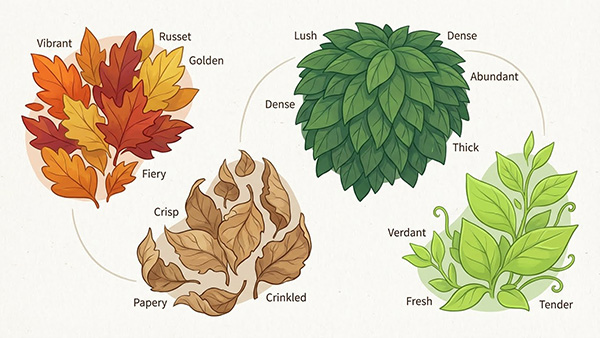
When exploring nature, having a strong vocabulary of words to describe a leaf can make your writing more vivid and precise. This guide covers a range of adjectives to describe leaves as well as terms for describing leaves, allowing you to highlight shape, color, and texture effectively. By mastering how to describe plant leaves, you can communicate subtle differences between species with clarity and creativity.
Adjectives are words that describe or modify nouns. When we talk about “adjectives for leaves,” we’re referring to the words that provide specific details about the characteristics of leaves. These adjectives can describe a leaf’s color, shape, size, texture, condition, type, origin, or pattern. They help us create a more vivid and detailed image of the leaf in our minds.
Adjectives play a crucial role in descriptive writing and speech. They allow us to differentiate between various leaves, highlight their unique features, and convey precise information. For example, instead of simply saying “a leaf,” we can say “a crimson leaf” or “a serrated leaf,” painting a much clearer picture.
In the context of grammar, adjectives typically precede the noun they modify (e.g., “the green leaf”) or follow a linking verb (e.g., “the leaf is green“). Understanding their function and placement is essential for using them correctly.
Young Adults & Students:
Get 6 Months of Prime for $0

Ages 18-24 unlock exclusive perks including:
Contains affiliate link
Structural Breakdown
Adjectives, in general, adhere to certain structural rules within a sentence. When describing leaves, these rules remain consistent with broader grammatical principles.
Here’s a breakdown:
- Placement: Adjectives usually come before the noun they modify. For example: “The fragrant leaf fell to the ground.”
- Multiple Adjectives: When using multiple adjectives, a general order is often followed, though it’s not a rigid rule. A common order is: Opinion, Size, Age, Shape, Color, Origin, Material, Type, Purpose. For example: “The beautiful small old oval green Japanese paper leaf.” While such a string of adjectives is rare and can sound awkward, it illustrates the order.
- Coordinate Adjectives: Coordinate adjectives are adjectives that modify the same noun equally. They are separated by commas or the word “and.” For example: “The leaf was bright, colorful, and vibrant.”
- Cumulative Adjectives: Cumulative adjectives build upon each other to modify the noun. They are not separated by commas. For example: “The dark green leaf.” Here, ‘dark’ modifies ‘green,’ and together they modify ‘leaf.’
- Linking Verbs: Adjectives can also follow linking verbs such as is, are, was, were, seems, appears, becomes. For example: “The leaf is wilted.”
Understanding these structural elements helps ensure that adjectives are used correctly and effectively to describe leaves.
Types and Categories of Adjectives for Leaves
Adjectives for leaves can be categorized based on the specific characteristic they describe. Here are some key categories:
Color Adjectives
These adjectives describe the color of the leaf. Common examples include:
- Green
- Red
- Yellow
- Brown
- Orange
- Purple
- Golden
- Crimson
- Scarlet
- Emerald
- Olive
- Lime
- Russet
- Maroon
- Chartreuse
For plants that retain foliage year-round, it’s helpful to know specific words to describe evergreen leaves. Terms like “needle-like,” “waxy,” or “lustrous” can convey the unique characteristics of these long-lasting leaves.
Shape Adjectives
These adjectives describe the shape of the leaf. Examples include:
- Oval
- Round
- Heart-shaped
- Lance-shaped
- Needle-like
- Fan-shaped
- Lobed
- Serrated
- Toothed
- Elliptical
- Linear
- Palmate
- Peltate
- Obovate
- Cordate
Size Adjectives
These adjectives describe the size of the leaf. Examples include:
- Small
- Large
- Tiny
- Huge
- Miniature
- Gigantic
- Broad
- Narrow
- Long
- Short
- Wide
- Slender
- Compact
- Expansive
- Substantial
Texture Adjectives
These adjectives describe the texture of the leaf. Examples include:
- Smooth
- Rough
- Glossy
- Velvety
- Leathery
- Hairy
- Downy
- Prickly
- Waxy
- Silky
- Papery
- Coarse
- Fine
- Slippery
- Bristly
Condition Adjectives
These adjectives describe the condition of the leaf. Examples include:
- Fresh
- Wilted
- Dry
- Crisp
- Brittle
- Rotting
- Decaying
- Healthy
- Damaged
- Perfect
- Torn
- Faded
- Vibrant
- Moldy
- Yellowing
Type Adjectives
These adjectives describe the type or classification of the leaf.
- Simple
- Compound
- Deciduous
- Evergreen
- Coniferous
- Broadleaf
- Spatulate
- Sessile
- Petiolate
- Auriculate
- Perfoliate
Origin Adjectives
These adjectives describe the origin or source of the leaf.
- Maple
- Oak
- Birch
- Willow
- Pine
- Eucalyptus
- Tropical
- Temperate
- Australian
- Asian
- American
Pattern Adjectives
These adjectives describe patterns or markings on the leaf.
- Variegated
- Spotted
- Striped
- Marbled
- Mottled
- Speckled
- Blotched
- Ringed
- Banded
When describing trees heavy with greenery, understanding how to describe a lot of leaves in a tree can help create vivid imagery. Writers often use adjectives to describe foliage such as “dense,” “lush,” “verdant,” or “thick” to convey abundance.
Additionally, the adjective version of foliage can be applied in sentences like “the foliaged branches swayed gently,” giving readers a clear sense of texture and volume while keeping descriptions precise and expressive.
Examples of Adjectives for Leaves
The following tables provide extensive examples of how these adjectives can be used to describe leaves in sentences.
Color Examples
This table showcases examples of sentences using color adjectives to describe leaves. Notice how the color adds detail and visual imagery to each description.
| Sentence |
|---|
| The green leaf shimmered in the sunlight. |
| The red leaves of the maple tree were stunning. |
| The yellow leaf crunched underfoot. |
| The brown leaves covered the forest floor. |
| The orange leaves signaled the arrival of autumn. |
| The purple leaf was a rare find. |
| The golden leaves glittered in the breeze. |
| The crimson leaf fell gracefully from the tree. |
| The scarlet leaves provided a vibrant contrast. |
| The emerald leaves were lush and vibrant. |
| The olive leaves rustled in the wind. |
| The lime leaves were a refreshing sight. |
| The russet leaves added warmth to the landscape. |
| The maroon leaf stood out among the others. |
| The chartreuse leaves were a bright and cheerful addition. |
| The forest was filled with green and gold leaves. |
| A single red leaf clung to the branch. |
| The path was covered in a carpet of brown and yellow leaves. |
| The artist painted the emerald green leaves with precision. |
| The garden featured a variety of colorful leaves. |
| The verdant leaves provided ample shade. |
| The autumn forest was a tapestry of fiery leaves. |
| The grey-green leaves of the eucalyptus tree were aromatic. |
| The blue-green leaves of the succulent were striking. |
| The silver leaves of the olive tree shimmered in the sun. |
| The bronze leaves of the beech tree were beautiful. |
| The copper colored leaves of the plant were eye-catching. |
Shape Examples
This table showcases examples of sentences using shape adjectives to describe leaves. The shape helps to define the type and origin of the leaf.
| Sentence |
|---|
| The oval leaf was smooth to the touch. |
| The round leaf resembled a small plate. |
| The heart-shaped leaf was a symbol of love. |
| The lance-shaped leaf was sharp and pointed. |
| The needle-like leaves of the pine tree were evergreen. |
| The fan-shaped leaf of the ginkgo tree was unique. |
| The lobed leaf was characteristic of oak trees. |
| The serrated leaf had a jagged edge. |
| The toothed leaf was similar to a saw. |
| The elliptical leaf was wider in the middle. |
| The linear leaf was long and narrow. |
| The palmate leaf resembled a hand. |
| The peltate leaf had a stem attached to the center. |
| The obovate leaf was wider at the tip. |
| The cordate leaf was shaped like a heart at the base. |
| The triangular leaves were small and delicate. |
| The arrowhead-shaped leaves grew along the water’s edge. |
| The plant featured scale-like leaves pressed tightly together. |
| The crescent-shaped leaves were an unusual sight. |
| The diamond-shaped leaves caught the sunlight. |
| The asymmetrical leaf had a unique, irregular shape. |
| The kidney-shaped leaves were bright green. |
| The spoon-shaped leaves held droplets of water. |
| The strap-shaped leaves were long and slender. |
| The lyrate leaves were deeply lobed. |
| The rhomboid leaves were geometrically appealing. |
| The deltoid leaves were triangular. |
Size Examples
This table showcases examples of sentences using size adjectives to describe leaves.
| Sentence |
|---|
| The small leaf fluttered in the breeze. |
| The large leaf provided ample shade. |
| The tiny leaf was barely visible. |
| The huge leaf was almost as big as my head. |
| The miniature leaves were delicate and intricate. |
| The gigantic leaves of the tropical plant were impressive. |
| The broad leaf offered excellent coverage. |
| The narrow leaf was easily overlooked. |
| The long leaf swayed gently in the wind. |
| The short leaf was surprisingly sturdy. |
| The wide leaf was perfect for catching raindrops. |
| The slender leaf was elegant and graceful. |
| The compact leaves formed a dense canopy. |
| The expansive leaves covered a large area. |
| The substantial leaf felt thick and strong. |
| The petite leaves were a charming addition to the arrangement. |
| The oversized leaves created a dramatic effect. |
| The plant had dwarf leaves, remaining small and compact. |
| The voluminous leaves provided a thick screen. |
| The minute leaves were barely noticeable to the naked eye. |
| The extensive leaves were all over the ground. |
| The imposing leaves towered over the garden. |
| The minuscule leaves were hardly bigger than a pinhead. |
| The ample leaves provided plenty of shade. |
| The considerable leaves were impressive in size. |
| The slight leaves were delicate and easily damaged. |
| The massive leaves of the banana tree were striking. |
Texture Examples
This table showcases examples of sentences using texture adjectives to describe leaves.
| Sentence |
|---|
| The smooth leaf felt cool to the touch. |
| The rough leaf scratched my hand. |
| The glossy leaf reflected the sunlight. |
| The velvety leaf was soft and luxurious. |
| The leathery leaf was tough and durable. |
| The hairy leaf felt fuzzy. |
| The downy leaf was covered in fine hairs. |
| The prickly leaf deterred animals from eating it. |
| The waxy leaf repelled water. |
| The silky leaf shimmered in the light. |
| The papery leaf crinkled when touched. |
| The coarse leaf felt rough and uneven. |
| The fine leaf had a delicate texture. |
| The slippery leaf was difficult to hold. |
| The bristly leaf had stiff, sharp hairs. |
| The satiny leaf felt smooth and lustrous. |
| The gritty leaves were covered in fine particles of sand. |
| The fleecy leaves were soft and fluffy. |
| The pimpled leaves had small raised bumps. |
| The slick leaves were dangerously smooth when wet. |
| The nubbly leaves had a slightly bumpy texture. |
| The sandpapery leaves were extremely rough. |
| The scaly leaves overlapped like fish scales. |
| The spongy leaves absorbed water easily. |
| The corrugated leaves had a ridged texture. |
| The crinkled leaves looked wrinkled and aged. |
| The fuzzy leaves were soft and comforting to touch. |
Condition Examples
This table showcases examples of sentences using condition adjectives to describe leaves.
| Sentence |
|---|
| The fresh leaf was vibrant and full of life. |
| The wilted leaf drooped sadly. |
| The dry leaf crumbled in my hand. |
| The crisp leaf shattered when I stepped on it. |
| The brittle leaf snapped easily. |
| The rotting leaf smelled unpleasant. |
| The decaying leaf was returning to the earth. |
| The healthy leaf was a sign of a thriving plant. |
| The damaged leaf had holes and tears. |
| The perfect leaf was flawless. |
| The torn leaf hung precariously from the branch. |
| The faded leaf had lost its color. |
| The vibrant leaf stood out against the others. |
| The moldy leaf was covered in fungus. |
| The yellowing leaf signaled the end of its life. |
| The blemished leaves were marred by spots and discoloration. |
| The scorched leaves were damaged by the sun. |
| The shriveled leaves were dry and wrinkled. |
| The spotless leaves were pristine and untouched. |
| The tattered leaves were torn and frayed. |
| The blistered leaves were raised and swollen. |
| The gnawed leaves showed signs of insect damage. |
| The preserved leaves were carefully dried and protected. |
| The sturdy leaves withstood the strong winds. |
| The fragile leaves were easily broken. |
| The resilient leaves bounced back after the storm. |
| The spent leaves had completed their life cycle. |
Capturing the moment when a leaf falls can add a dynamic touch to writing. Phrases like “the brittle leaf tumbled to the ground” or “the crimson leaf drifted softly” illustrate how to describe a leaf hitting the floor vividly and poetically.
Usage Rules for Adjectives for Leaves
Using adjectives correctly involves understanding a few key rules:
- Adjective Order: As mentioned earlier, there’s a general order for multiple adjectives. While not strict, it’s helpful to keep in mind. For example, “a beautiful, large, green leaf” sounds more natural than “a green, large, beautiful leaf.”
- Coordinate Adjectives: Use commas to separate coordinate adjectives. For example, “The leaf was bright, colorful.” If you can insert “and” between the adjectives and the sentence still makes sense, they are coordinate.
- Cumulative Adjectives: Do not use commas between cumulative adjectives. For example, “The dark green leaf.”
- Proper Adjectives: Adjectives derived from proper nouns (e.g., “Japanese maple leaf”) should be capitalized.
- Hyphenated Adjectives: Use hyphens for compound adjectives that come before the noun. For example, “The heart-shaped leaf.” If the compound adjective follows the noun, a hyphen is usually not needed (e.g., “The leaf was heart shaped.”).
Understanding and applying these rules will enhance the clarity and correctness of your writing.
Common Mistakes
Here are some common mistakes to avoid when using adjectives for leaves:
| Incorrect | Correct | Explanation |
|---|---|---|
| The leaf green was. | The leaf was green. | Adjectives typically precede the noun or follow a linking verb. |
| A green, large, beautiful leaf. | A beautiful, large, green leaf. | Adjective order should be followed for a more natural flow. |
| The heart shaped leaf. | The heart-shaped leaf. | Compound adjectives before a noun should be hyphenated. |
| Japanese Maple leaf. | Japanese maple leaf. | Only the proper noun (Japanese) should be capitalized, not the common noun (maple). |
| The leaf was brightly, colorful. | The leaf was bright and colorful. | If you can insert “and” between the adjectives and the sentence still makes sense, they are coordinate. |
| The more green leaf. | The greener leaf. | Use comparative forms correctly (e.g., greener instead of more green). |
| Leaf’s color is green. | The leaf’s color is green. | Make sure to use the correct possessive form. |
| The leaf is very greenest. | The leaf is very green. | Do not use superlative form with ‘very’. |
Practice Exercises
Test your knowledge with these practice exercises. Choose the best adjective to complete each sentence.
| Question | Answer |
|---|---|
| 1. The _______ leaves of the oak tree turned brown in autumn. (a) green (b) red (c) yellow | (a) green |
| 2. The _______ leaf felt smooth and cool to the touch. (a) rough (b) velvety (c) smooth | (c) smooth |
| 3. The _______ leaves of the pine tree are evergreen. (a) broad (b) needle-like (c) round | (b) needle-like |
| 4. The _______ leaf was torn and faded. (a) fresh (b) damaged (c) vibrant | (b) damaged |
| 5. The _______ leaves of the maple tree were stunning in the fall. (a) blue (b) red (c) white | (b) red |
| 6. The _______ leaf crunched under my feet as I walked through the forest. (a) wet (b) dry (c) damp | (b) dry |
| 7. The _______ leaf was shaped like a fan. (a) oval (b) heart-shaped (c) fan-shaped | (c) fan-shaped |
| 8. The _______ leaves provided ample shade on the hot summer day. (a) tiny (b) large (c) small | (b) large |
| 9. The _______ leaf felt waxy and repelled water. (a) velvety (b) rough (c) waxy | (c) waxy |
| 10. The _______ leaves were a sign of the plant’s health and vitality. (a) rotting (b) healthy (c) decaying | (b) healthy |
Exercise 2: Rewrite the following sentences using more descriptive adjectives.
| Original Sentence | Rewritten Sentence |
|---|---|
| 1. The leaf was green. | The emerald green leaf shimmered in the sunlight. |
| 2. The leaf was big. | The expansive leaf provided ample shade. |
| 3. The leaf was rough. | The coarse leaf scratched against my skin. |
| 4. The leaf was damaged. | The torn and faded leaf hung precariously from the branch. |
| 5. The leaf was round. | The round leaf resembled a small, green plate. |
| 6. The leaf fell to the ground. | The brittle, brown leaf fell silently to the forest floor. |
| 7. The tree had leaves. | The ancient oak tree boasted vibrant, green leaves. |
| 8. The leaf was wet. | The slippery, wet leaf slid through my fingers. |
| 9. The leaf was small. | The petite leaf danced in the gentle breeze. |
| 10. The plant had leaves. | The exotic plant featured glossy, variegated leaves. |
Exercise 3: Identify the type of adjective used in each sentence (color, shape, size, texture, condition).
| Sentence | Type of Adjective |
|---|---|
| 1. The red leaf fell from the tree. | Color |
| 2. The oval leaf was smooth to the touch. | Shape |
| 3. The large leaf provided shade. | Size |
| 4. The velvety leaf felt soft. | Texture |
| 5. The wilted leaf drooped sadly. | Condition |
| 6. The tiny leaf was barely visible. | Size |
| 7. The glossy leaf reflected sunlight. | Texture |
| 8. The heart-shaped leaf was unique. | Shape |
| 9. The dry leaf crumbled easily. | Condition |
| 10. The golden leaf glittered in the sun. | Color |
Advanced Topics
For advanced learners, consider exploring these more complex aspects:
- Figurative Language: How adjectives for leaves can be used in metaphors, similes, and personification to create vivid imagery.
- Literary Analysis: Analyzing how authors use adjectives for leaves to convey specific moods or themes in literature.
- Scientific Terminology: Delving into the specific scientific terms used to describe leaf characteristics in botany.
- Cross-Cultural Comparisons: Examining how different cultures perceive and describe leaves, and how their languages reflect these perceptions.
Further study in these areas will deepen your understanding and appreciation of the nuances of descriptive language.
Frequently Asked Questions
Here are some frequently asked questions about using adjectives for leaves:
What is the correct order for multiple adjectives?
The general order is: Opinion, Size, Age, Shape, Color, Origin, Material, Type, Purpose. However, this is not a strict rule, and the most important thing is to ensure the sentence sounds natural.
How do I know if I should use a comma between adjectives?
If the adjectives are coordinate (i.e., they modify the noun equally and you can insert “and” between them), use a comma. If they are cumulative (i.e., they build upon each other), do not use a comma.
Should I capitalize adjectives derived from proper nouns?
Yes, adjectives derived from proper nouns (e.g., “Japanese”) should be capitalized.
What is the difference between “serrated” and “toothed” when describing a leaf?
“Serrated” generally refers to saw-like teeth that point forward, while “toothed” is a more general term for any leaf edge with tooth-like projections.
How can I improve my vocabulary of adjectives for leaves?
Read widely, pay attention to descriptive language in literature and nature writing, and use a thesaurus to find synonyms and related terms. Practice using new adjectives in your own writing and speaking.
Are there any adjectives that should be avoided when describing leaves?
Avoid using vague or overused adjectives like “nice” or “good.” Instead, opt for more specific and descriptive words that capture the unique characteristics of the leaf.
What is the best way to describe the color of a leaf that has multiple colors?
You can use adjectives like “variegated,” “mottled,” or “multicolored.” You can also describe the specific colors present, such as “green with yellow edges” or “red and orange striped.”
How can I use adjectives to create a specific mood or atmosphere when describing leaves?
Choose adjectives that evoke the desired emotion or feeling. For example, “wilted” and “decaying” can create a sense of sadness or decline, while “vibrant” and “fresh” can evoke a sense of joy and vitality.
Conclusion
Mastering adjectives for leaves is a valuable skill for anyone looking to enhance their descriptive abilities in English. By understanding the different categories of adjectives, their usage rules, and common mistakes to avoid, you can effectively paint vivid pictures with your words and communicate more precisely about the natural world.
The examples and practice exercises provided in this guide offer a solid foundation for continued learning and improvement.
Continue to expand your vocabulary, pay attention to the descriptive language used by others, and practice using adjectives in your own writing and speaking. With dedication and effort, you can become a skilled and confident describer of leaves and all the wonders of nature.

M. Thomas writes language-learning guides for EnglishScribe, covering grammar, vocabulary, and everyday expressions. Through clear explanations, practical examples, and exercises, Thomas helps ESL learners understand English and build confidence in using it.