Describing Speed: A Guide to Adjectives for “Fast”
Describing speed accurately and effectively is crucial in English communication. While “fast” is a common adjective, the English language offers a rich variety of words to depict different nuances of speed, ranging from brisk to lightning-quick.
Expanding your vocabulary with fast descriptive words allows you to add precision and color to your writing. Beyond “fast,” words like brisk, fleet, zippy, and lightning convey different shades of speed. Some highlight elegance and agility, while others focus on intensity or urgency.
By selecting the most fitting descriptive word, you can portray not just movement, but also energy, efficiency, or immediacy, depending on the context. Using a variety of adjectives keeps your writing engaging and more expressive.
Off to College Deals

Save up to 30% on everything you need for the semester.
Contains affiliate link
Understanding these adjectives not only enhances your vocabulary but also allows you to convey more precise and vivid descriptions. This article explores a comprehensive range of adjectives for “fast,” providing definitions, examples, usage rules, and practice exercises to help you master this essential aspect of English grammar.
This guide is beneficial for English language learners of all levels, from beginners looking to expand their vocabulary to advanced speakers aiming to refine their descriptive skills.
Table of Contents
- Introduction
- Definition of “Fast” and Related Adjectives
- Structural Breakdown
- Types and Categories of Adjectives for “Fast”
- Examples of Adjectives for “Fast” in Sentences
- Usage Rules for Adjectives Describing “Fast”
- Common Mistakes When Using Adjectives for “Fast”
- Practice Exercises
- Advanced Topics
- Frequently Asked Questions (FAQ)
- Conclusion
Definition of “Fast” and Related Adjectives
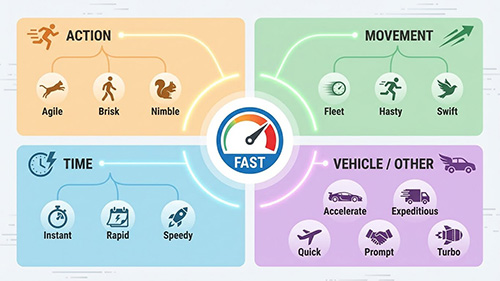
When discussing adjectives for “fast,” it is important to recognize that “fast” functions as a quality adjective. This means it describes the inherent characteristic or property of a noun, such as the ability of a car to move quickly or a runner’s speed. Using “fast” as a quality adjective helps convey not only motion but also competence, efficiency, or excellence in action.
The adjective “fast” generally describes something that moves or operates at a high speed. However, the English language provides a plethora of adjectives that offer more nuanced descriptions of speed, quickness, and related concepts.
When describing someone’s ability to move quickly, adjectives like nimble, agile, fleet-footed, or quick-footed work well. These words emphasize physical capability, highlighting speed combined with control or skill. Choosing the right adjective ensures clarity—“nimble” suggests graceful quickness, while “fleet-footed” conveys both speed and endurance.
Young Adults & Students:
Get 6 Months of Prime for $0

Ages 18-24 unlock exclusive perks including:
Contains affiliate link
These adjectives can describe not only physical movement but also mental processes, reaction times, and even the pace of events.
Classification: Adjectives of quality (descriptive adjectives).
Function: To modify nouns and pronouns, providing information about their speed, quickness, or related attributes.
Contexts: Used in a wide range of contexts, including describing vehicles, animals, people, processes, and events.
Structural Breakdown
Adjectives for “fast” typically precede the noun they modify. They can also follow a linking verb (e.g., is, are, was, were, seems) to describe the subject of the sentence. Understanding the placement and function of these adjectives is crucial for constructing grammatically correct and meaningful sentences.
Basic Structure:
- Adjective + Noun: a rapid increase, a swift runner, a quick decision
- Subject + Linking Verb + Adjective: The car is fast. The response was immediate.
Adjectives can also be modified by adverbs of degree to further refine their meaning. For example:
- Adverb of Degree + Adjective + Noun: a very fast car, an incredibly quick response
Types and Categories of Adjectives for “Fast”
Adjectives that describe “fast” can be grouped into several categories based on the specific aspect of speed or quickness they emphasize.
Adjectives Describing Speed or Rate
These adjectives focus on the rate at which something moves or occurs. They often relate to measurable speed.
- Fast: The most general term, indicating high speed.
- Rapid: Suggests a high rate of occurrence or movement.
- Quick: Implies speed and efficiency.
- Swift: Conveys a sense of rapid and graceful movement.
- Expeditious: Highlights speed and efficiency in completing a task.
- Accelerated: Indicates an increase in speed.
Adjectives Describing Quickness or Promptness
These adjectives emphasize the speed of response, reaction, or completion.
- Prompt: Indicates immediate or timely action.
- Immediate: Suggests happening without delay.
- Instantaneous: Describes something that occurs in an instant.
- Expeditious: Highlights speed and efficiency in completing a task.
- Ready: Prepared and quick to act.
Adjectives Describing Swiftness or Rapidity
These adjectives emphasize the speed of movement, often with a sense of grace or force.
- Swift: Conveys a sense of rapid and graceful movement.
- Rapid: Suggests a high rate of occurrence or movement.
- Breakneck: Dangerously fast.
Adjectives Describing Agility or Nimbleness
These adjectives describe the ability to move quickly and easily.
- Nimble: Suggests quickness and agility in movement.
- Agile: Implies the ability to move quickly and easily.
Adjectives Describing Suddenness or Abruptness
These adjectives emphasize the unexpected and immediate nature of an action or event.
- Sudden: Occurring quickly and unexpectedly.
- Abrupt: Suggests a sudden and unexpected change or stop.
Examples of Adjectives for “Fast” in Sentences
The following tables provide examples of how different adjectives for “fast” can be used in sentences. Each table focuses on a specific category of adjectives, illustrating their usage in various contexts.
Table 1: Adjectives Describing Speed or Rate
This table showcases adjectives that directly describe the speed or rate at which something moves or occurs.
| Adjective | Example Sentence |
|---|---|
| Fast | The fast car sped down the highway. |
| Rapid | There was a rapid increase in sales after the new marketing campaign. |
| Quick | She made a quick decision to accept the job offer. |
| Swift | The swift current carried the boat downstream. |
| Expeditious | The company provided expeditious service to its customers. |
| Accelerated | The accelerated pace of technological advancements is transforming society. |
| Brisk | They took a brisk walk through the park. |
| Headlong | The company rushed headlong into the new venture. |
| Hasty | Try not to make any hasty decisions. |
| Fleeting | She caught a fleeting glimpse of him. |
| Fleet | The fleet of ships sailed into the harbor. |
| Sped-up | The video was shown in sped-up mode. |
| High-speed | The train is a high-speed rail service. |
| Lightening | The lightening reflexes of the goalkeeper saved the day. |
| Express | The express train does not stop at all stations. |
| Flying | The doctor prescribed flying visits to remote areas. |
| Breakneck | He was driving at a breakneck speed. |
| Superfast | The restaurant offers superfast delivery. |
| Zippy | The new car has a zippy engine. |
| Nimble | The nimble fingers of the pianist flew across the keys. |
| Whizzing | The cars were whizzing along the highway. |
| Rattling | The rattling train sped down the tracks. |
| Scorching | The runner set a scorching pace in the race. |
| Snappy | The company has a snappy order fulfillment process. |
| Top-speed | The car reached its top-speed on the straightaway. |
Table 2: Adjectives Describing Quickness or Promptness
This table provides examples of adjectives that emphasize the speed of response, reaction, or completion.
| Adjective | Example Sentence |
|---|---|
| Prompt | The company provided prompt customer service. |
| Immediate | The effect of the medicine was immediate. |
| Instantaneous | The reaction was instantaneous when the chemical was added. |
| Expeditious | The team handled the project in an expeditious manner. |
| Ready | The soldiers were ready for battle. |
| Hair-trigger | The machine has a hair-trigger response. |
| Magic | The chef produced a magic dish. |
| Rapid-fire | The comedian delivered a rapid-fire monologue. |
| Sharp | The company has a sharp response to market changes. |
| Summary | The judge made a summary decision in the case. |
| Unhesitating | The witness gave an unhesitating account of the event. |
| Lightning | The lightning reflexes of the cat saved it from danger. |
| Split-second | The driver made a split-second decision to avoid the accident. |
| Wink-quick | The magician performed a wink-quick trick. |
| Hot | The company has a hot response to customer requests. |
| Electric | The crowd had an electric reaction to the performance. |
| On-the-spot | The manager made an on-the-spot decision to hire the candidate. |
| Hasty | The company made a hasty response to the crisis. |
| Zip | The company has a zip response to customer inquiries. |
| Expresso | The company provides expresso service to customers. |
| Dashing | The company has a dashing response to market trends. |
| Racy | The company has a racy response to competition. |
| Sprightly | The company has a sprightly response to challenges. |
| Nimble | The company has a nimble response to changing market conditions. |
| On-the-double | The team provided service on-the-double. |
Table 3: Adjectives Describing Swiftness or Rapidity
This table illustrates adjectives used to describe the speed of movement, emphasizing grace or force.
| Adjective | Example Sentence |
|---|---|
| Swift | The swift eagle soared through the sky. |
| Rapid | The rapid flow of the river eroded the banks. |
| Breakneck | They drove down the mountain road at a breakneck pace. |
| Flying | The child came in on a flying visit. |
| Expeditious | The matter was dealt with in an expeditious manner. |
| Spanking | The ship sailed at a spanking pace. |
| High-velocity | The high-velocity wind battered the coast. |
| Hurried | They took a hurried walk to the store. |
| Screaming | The car traveled at a screaming pace. |
| Whirlwind | The company had a whirlwind romance. |
| Scampering | The children were scampering around in the yard. |
| Blistering | The runner set a blistering pace in the race. |
| Whizzing | The train was whizzing through the countryside. |
| Rattling | The rattling train sped down the tracks. |
| Lightening | The boxer had lightening punches. |
| Supercharged | The company had a supercharged growth rate. |
| Winged | The company had a winged response to the crisis. |
| Streaking | The company had a streaking growth rate. |
| Snappy | The company has a snappy order fulfillment process. |
| Top-speed | The car reached its top-speed on the straightaway. |
| Express | The express train does not stop at all stations. |
| Fleet | The fleet of ships sailed into the harbor. |
| Zippy | The new car has a zippy engine. |
| Giddy | The company has a giddy response to the market. |
| Scorching | The runner set a scorching pace in the race. |
Table 4: Adjectives Describing Agility or Nimbleness
This table features adjectives that describe the ability to move quickly and easily.
| Adjective | Example Sentence |
|---|---|
| Nimble | The nimble dancer moved gracefully across the stage. |
| Agile | The agile athlete excelled in gymnastics. |
| Catlike | The thief moved with catlike stealth. |
| Sleek | The sleek car moved through the traffic. |
| Spry | The spry old man still went running every morning. |
| Lithe | The lithe gymnast performed with grace. |
| Light-footed | The ballerina was light-footed on stage. |
| Fleet-footed | The fleet-footed runner won the race. |
| Quick-witted | He was a quick-witted conversationalist. |
| Deft | The surgeon had deft hands. |
| Swift-footed | The swift-footed animal ran across the plain. |
| Dainty | The dainty dancer moved with precision. |
| Springy | The cat had a springy step. |
| Lissome | The lissome dancer moved with grace. |
| Sure-footed | The mountain climber was sure-footed on the rocks. |
| Light | The dancer had a light step. |
| Flying | The company had a flying response to the crisis. |
| Winged | The company had a winged response to the crisis. |
| Snappy | The company has a snappy order fulfillment process. |
| Top-speed | The car reached its top-speed on the straightaway. |
| Express | The express train does not stop at all stations. |
| Fleet | The fleet of ships sailed into the harbor. |
| Zippy | The new car has a zippy engine. |
| Giddy | The company has a giddy response to the market. |
| Scorching | The runner set a scorching pace in the race. |
Table 5: Adjectives Describing Suddenness or Abruptness
This table showcases adjectives that emphasize the unexpected and immediate nature of an action or event.
| Adjective | Example Sentence |
|---|---|
| Sudden | There was a sudden change in the weather. |
| Abrupt | The car came to an abrupt stop. |
| Spontaneous | The trip was a spontaneous decision. |
| Unforeseen | The company had an unforeseen problem. |
| Improvised | The speech was an improvised performance. |
| Unpremeditated | The crime was an unpremeditated act. |
| Unplanned | The meeting was an unplanned gathering. |
| Hasty | The company made a hasty response. |
| Headlong | The company rushed headlong into the new venture. |
| Impulsive | The company made an impulsive purchase. |
| Momentary | The company had a momentary lapse in judgment. |
| Snappy | The company has a snappy order fulfillment process. |
| Top-speed | The car reached its top-speed on the straightaway. |
| Express | The express train does not stop at all stations. |
| Fleet | The fleet of ships sailed into the harbor. |
| Zippy | The new car has a zippy engine. |
| Giddy | The company has a giddy response to the market. |
| Scorching | The runner set a scorching pace in the race. |
| Lightening | The boxer had lightening punches. |
| Supercharged | The company had a supercharged growth rate. |
| Winged | The company had a winged response to the crisis. |
| Streaking | The company had a streaking growth rate. |
| Flickering | The company had a flickering response to the crisis. |
| Top-notch | The company had a top-notch response to the crisis. |
| Instant | The company saw an instant result. |
Usage Rules for Adjectives Describing “Fast”
Using adjectives for “fast” correctly involves understanding their nuances and connotations. Here are some key usage rules:
- Context Matters: Choose the adjective that best fits the context. For instance, “rapid” is more suitable for describing a process, while “swift” is better for describing movement.
- Adjective Order: When using multiple adjectives, follow the general order of adjectives in English (e.g., opinion, size, age, shape, color, origin, material, purpose).
- Subject-Verb Agreement: Ensure that the verb agrees with the subject of the sentence when using adjectives after linking verbs.
- Avoid Redundancy: Do not use multiple adjectives that convey the same meaning.
- Hyphenation: Use hyphens for compound adjectives that precede the noun (e.g., a high-speed train).
Common Mistakes When Using Adjectives for “Fast”
Here are some common mistakes to avoid when using adjectives for “fast”:
| Incorrect | Correct | Explanation |
|---|---|---|
| The car is rapid. | The car is fast. | “Rapid” is best used to describe processes or increases, not the inherent speed of an object. |
| A fastly car. | A fast car. | “Fastly” is not a standard adjective. Use “fast.” |
| The immediate quick response. | The immediate response. | Avoid redundancy by using only one adjective with a similar meaning. |
| The car with high speed. | The high-speed car. | Use a hyphen to form a compound adjective before the noun. |
| The response were quick. | The response was quick. | Ensure subject-verb agreement. |
| The rapid increase were noted. | The rapid increase was noted. | Ensure subject-verb agreement. |
| The team were swift. | The team was swift. | Ensure subject-verb agreement. |
| A more faster pace. | A faster pace. | Do not use ‘more’ with comparative adjectives ending in ‘-er’. |
| A most fastest car. | The fastest car. | Do not use ‘most’ with superlative adjectives ending in ‘-est’. |
| A very instantaneous reaction. | An instantaneous reaction. | Avoid using ‘very’ with adjectives that are already absolute. |
| The train is swift and fast. | The train is swift. | Avoid using two adjectives with similar meanings. |
| The car is rapid than the bike. | The car is faster than the bike. | Use the correct comparative form of the adjective. |
| A more quicker way. | A quicker way. | Avoid using ‘more’ with comparative adjectives ending in ‘-er’. |
| The company is promptlier. | The company is more prompt. | Use ‘more’ with adverbs that do not end in ‘-ly’. |
| A swift quick reaction. | A swift reaction. | Avoid using two adjectives with similar meanings. |
Practice Exercises
Test your understanding of adjectives for “fast” with these practice exercises.
Exercise 1: Fill in the Blanks
Choose the most appropriate adjective from the list below to complete each sentence. (fast, rapid, quick, swift, prompt)
| Question | Answer |
|---|---|
| 1. The __________ response from the emergency services saved many lives. | Prompt |
| 2. The __________ current of the river made swimming dangerous. | Swift |
| 3. There was a __________ increase in the number of cases reported. | Rapid |
| 4. She made a __________ decision to change her career path. | Quick |
| 5. The __________ car sped down the racetrack, leaving the others behind. | Fast |
| 6. The company expects a __________ turnaround on all orders. | Quick |
| 7. The __________ growth of the city is a major concern for planners. | Rapid |
| 8. The bird made a __________ dive to catch its prey. | Swift |
| 9. The __________ action of the firefighter prevented the fire from spreading. | Prompt |
| 10. The internet provides __________ access to information. | Fast |
Exercise 2: Sentence Completion
Complete each sentence with an appropriate adjective for “fast.”
| Question | Answer |
|---|---|
| 1. The __________ pace of modern life can be overwhelming. | Rapid |
| 2. The athlete’s __________ reflexes allowed him to win the competition. | Quick |
| 3. The __________ response from the customer service team was appreciated. | Prompt |
| 4. The __________ cheetah is the fastest land animal. | Swift |
| 5. The company’s __________ growth surprised everyone. | Rapid |
| 6. The __________ decision to invest paid off handsomely. | Quick |
| 7. The __________ typing skills of the secretary were impressive. | Rapid |
| 8. The __________ action of the police stopped the robbery. | Prompt |
| 9. The __________ eagle soared above the mountains. | Swift |
| 10. The __________ car was the most expensive in the showroom. | Fast |
Exercise 3: Error Correction
Identify and correct the errors in the following sentences.
| Question | Correct Answer |
|---|---|
| 1. The car is rapid than the bike. | The car is faster than the bike. |
| 2. A more quicker way to solve the problem. | A quicker way to solve the problem. |
| 3. The company is promptlier in responding to emails. | The company is more prompt in responding to emails. |
| 4. A swift quick reaction is needed. | A swift reaction is needed. |
| 5. The train is swift and fast. | The train is swift. |
| 6. The immediate quick answer was correct. | The immediate answer was correct. |
| 7. The rapid increase were noted. | The rapid increase was noted. |
| 8. The team were swift to act. | The team was swift to act. |
| 9. A very instantaneous reaction. | An instantaneous reaction. |
| 10. The car with high speed. | The high-speed car. |
Advanced Topics
For advanced learners, consider exploring the following topics:
- Figurative Language: How adjectives for “fast” are used in metaphors and similes.
- Collocations: Common word combinations with adjectives for “fast.”
- Regional Variations: Differences in usage between British and American English.
- Historical Changes: How the meanings and usage of these adjectives have evolved over time.
Frequently Asked Questions (FAQ)
Here are some frequently asked questions about adjectives for “fast”:
What is the difference between “fast” and “rapid”?
“Fast” is a general term indicating high speed, while “rapid” suggests a high rate of occurrence or increase. “Fast” is used to describe speed of an object, while “rapid” will be used to describe the rate of change.
When should I use “swift” instead of “fast”?
“Swift” conveys a sense of rapid and graceful movement. Use “swift” when describing something moving quickly and elegantly.
Is “fastly” a correct word?
No, “fastly” is not a standard adjective or adverb in modern English. Use “fast” as both an adjective and an adverb.
How can I improve my vocabulary of adjectives for “fast”?
Read widely, pay attention to the words authors use to describe speed, and practice using new adjectives in your own writing and speaking.
Are there any adjectives that are similar to “fast” but have negative connotations?
Yes, adjectives like “breakneck” (dangerously fast) and “hasty” (carelessly fast) have negative connotations.
Can I use adjectives for “fast” to describe abstract concepts?
Yes, you can use adjectives for “fast” metaphorically to describe abstract concepts such as “rapid progress” or a “quick decision.”
What is the difference between ‘prompt’ and ‘immediate’?
‘Prompt’ suggests timely action, while ‘immediate’ suggests action without any delay. ‘Prompt’ is more about meeting an expected timeframe, while ‘immediate’ is about happening instantly.
How do I choose the best adjective for ‘fast’ in my writing?
Consider the specific aspect of speed you want to emphasize. Think about whether you want to highlight the rate of movement, the quickness of a response, or the agility of an action, and choose the adjective that best fits that nuance.
Conclusion
Mastering adjectives for “fast” is essential for enhancing your descriptive abilities in English. By understanding the nuances of words like “rapid,” “swift,” “quick,” and “prompt,” you can communicate more precisely and vividly.
This article has provided a comprehensive overview of these adjectives, including definitions, examples, usage rules, and practice exercises. Remember to consider the context, avoid common mistakes, and continue expanding your vocabulary to become a more confident and effective English speaker and writer.
Practice using these adjectives in your daily communication to solidify your understanding and improve your fluency.

M. Thomas writes language-learning guides for EnglishScribe, covering grammar, vocabulary, and everyday expressions. Through clear explanations, practical examples, and exercises, Thomas helps ESL learners understand English and build confidence in using it.